ChatGPT Wardrobe: how to use your real clothes with ChatGPT
Connect your wardrobe with Modebase
It is 7.40 on a Tuesday, I am standing in front of an open wardrobe in a towel, and I have asked my phone what to wear.
ChatGPT answers immediately, because it always does. A camel trench, it says. A crisp white shirt. Ecru wide-leg trousers, some gold hoops, a loafer.
It sounds lovely. It is also a detailed description of somebody else's wardrobe. I do not own a camel trench. I have never owned a camel trench. Somewhere in the enormous averaged mind of the internet there is a woman who owns a camel trench and is always, always being recommended back to me.
This is worth being precise about, because the problem is not the advice. Ask about proportion, or colour, or what a September wedding in a garden asks of you, and what comes back is sensible. It is not styling, not really. Styling is a person who can see you, knows the shape of your week and tells you the truth about the dress. What this is, is a sensible second opinion at 7.40 on a Tuesday, when no person is available and you are standing in a towel.
What goes wrong goes wrong in three places, and not one of them is the advice.
It does not hold your clothes. Hence the camel trench. And when you do tell it, by typing out a list, it holds the list badly. Pieces go missing. The navy one comes back as black and the midi as a maxi. The more you own, the worse it is at finding the right thing in it, so you end up dressed out of the same twenty pieces while the rest may as well not be there.
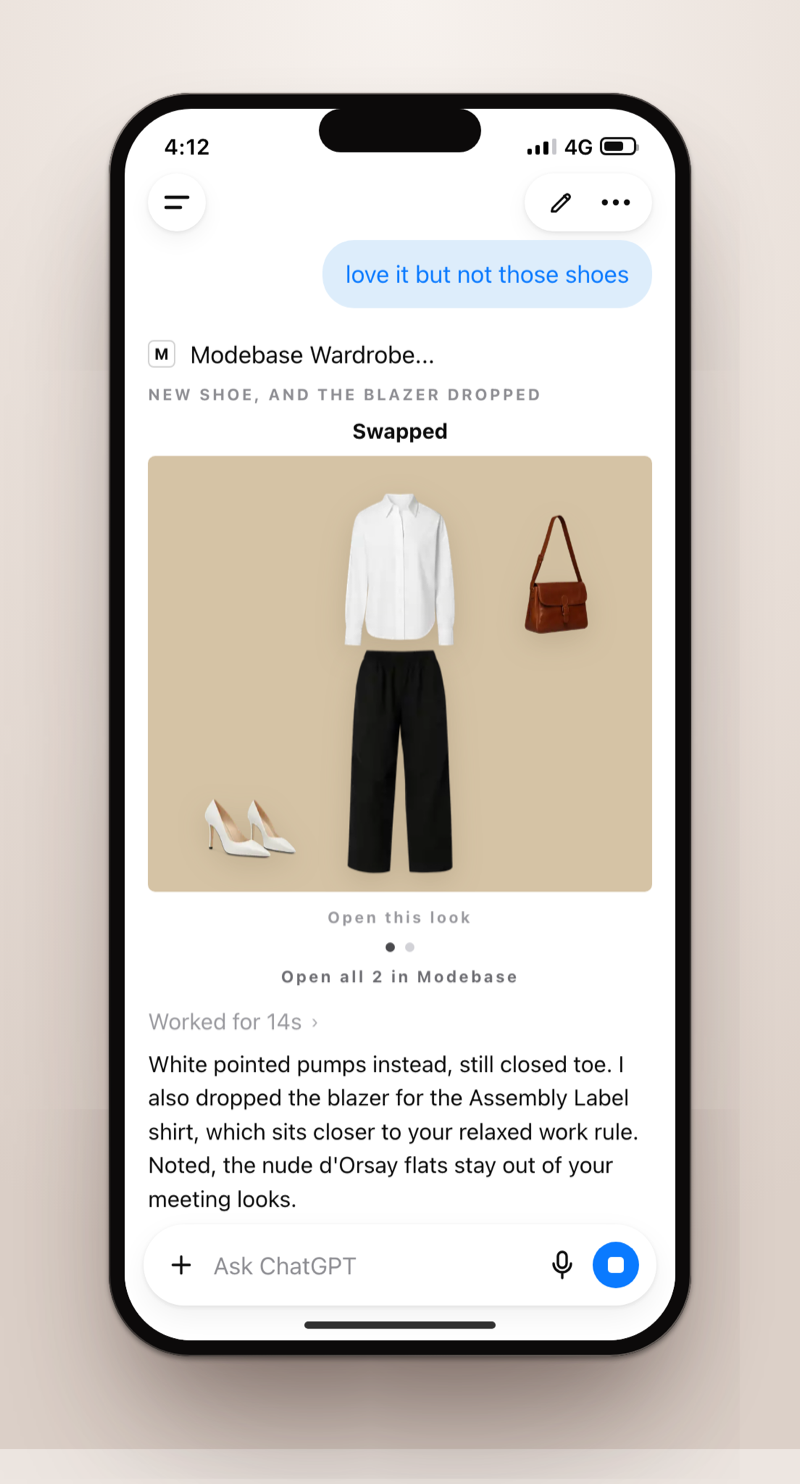
It does not know what you have been wearing. It puts you back in Tuesday's outfit. You say not that one again and it says it again. It offers you a combination you turned down last week with precisely the same enthusiasm as the first time. And the things you never reach for stay exactly where they are, because nothing is counting.
And it cannot show you anything. It is a paragraph of text about clothes. Clothes are visual. Nobody has ever decided what to wear by reading a description of their own jumper.
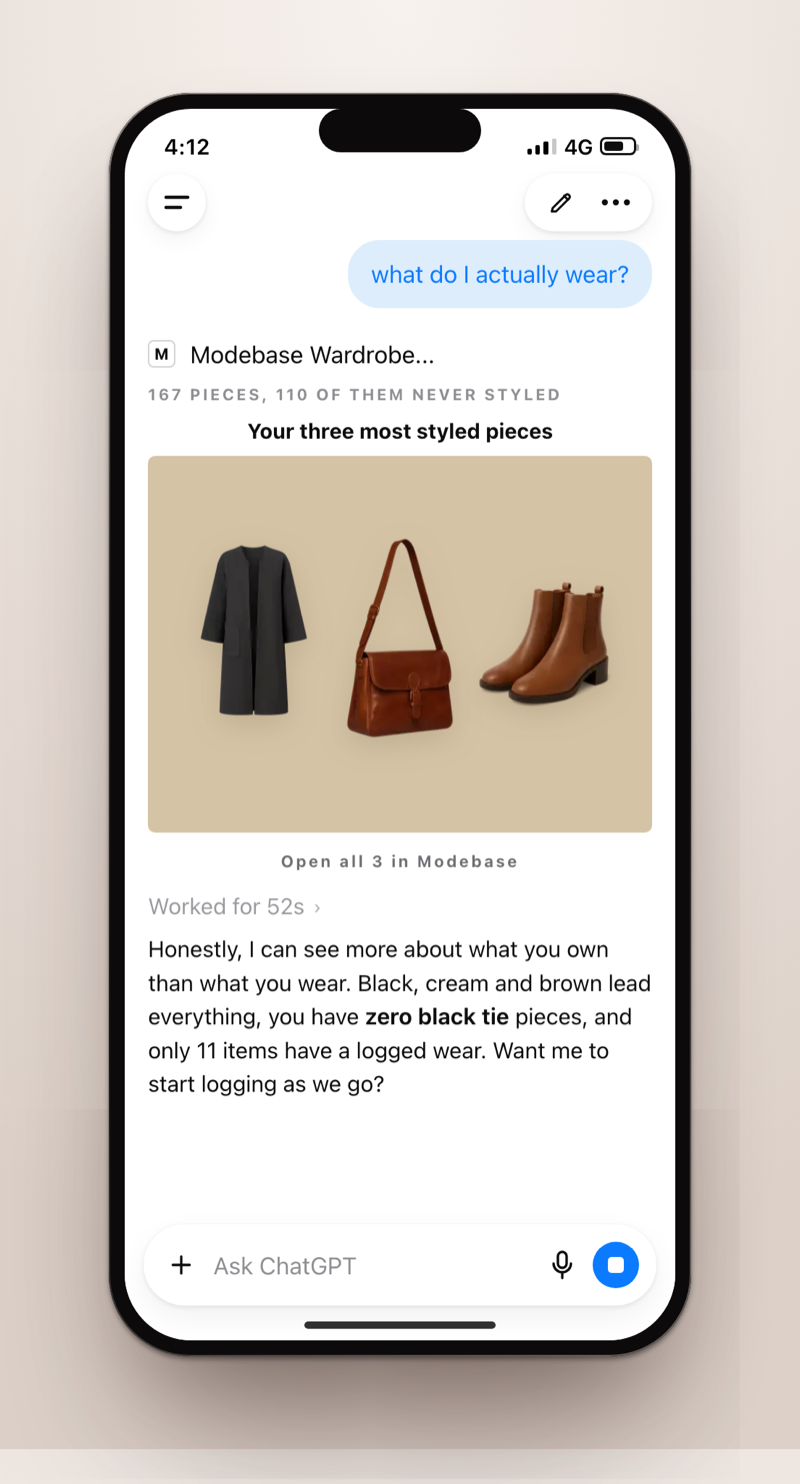
Modebase closes all three. It connects your actual wardrobe to ChatGPT, so the answer is built from pieces you own, it remembers what you wore and what you rejected on the pieces themselves, and it puts your real clothes in front of you as pictures. This guide is how that works, what to ask it once it does, and what it costs.
What changes once your wardrobe is connected
"What should I wear to work tomorrow?" Here is what changes once Modebase Wardrobe is connected and the assistant can see your clothes, and what does not.
| ChatGPT on its own | With Modebase Wardrobe connected | |
|---|---|---|
| Before you can ask | Paste or upload your clothes, and keep that list current by hand | Nothing. It already has them |
| The pieces it names | Usually at least one you do not own | Only things you own, with a reason for each |
| Tomorrow, in a new chat | It remembers your taste. Not your cupboard | Both, including the rules and corrections you have given it |
| What you wore | Not recorded anywhere, unless you write it down | Written back, if you turn wear tracking on, so it can avoid a repeat |
| What you end up with | Advice | An outfit, shown in the chat as your real pieces, and openable in Modebase to rearrange and save |
The five things everyone asks first
Can ChatGPT remember my wardrobe?
It remembers you, and rather well: that you never wear anything cropped, that your office is freezing in February, that you like a low heel. Worth setting up, and it is free.
What it does not hold is your cupboard. Not the four pairs of black trousers and how they differ, not which of them is actually navy, not the one that only works with a heel. That level of detail is what the difference between a nice suggestion and your outfit rests on, and it is what Modebase keeps: every piece recorded properly, and handed over the moment you ask.
Can I upload my wardrobe to ChatGPT?
You can, in two ways: type it out as a list, or upload photos of your clothes. Both are fine for a question or two.
But neither holds up as a wardrobe. A typed list has no pictures, so you never see anything, and once it gets long ChatGPT starts dropping pieces and guessing. Photos let you see, but ChatGPT limits how many it will take, loses the ones from earlier in the chat, and favours some over others almost at random. Either way it cannot tell your two black blazers apart, does not remember that the shoes hurt or what you thought of Tuesday's outfit, and cannot count, so "how many white shirts do I own" is a guess.
Modebase holds the same clothes as a wardrobe instead. Each piece with its colour, cut, fabric and how dressy it is, its cut-out image, your notes on it, and the outfits it has been in. That is the difference between a list of words and a wardrobe your assistant can actually work from.
How do I use ChatGPT as a personal stylist?
Gently, the honest answer first. It is not a stylist and it will not replace one. A stylist brings an eye, a structure and the willingness to tell you no, and a chat cannot come up with any of that on its own. What it is genuinely good at is taking knowledge it has been handed and applying it, patiently, at ten to eight in the morning.
So the job is handing it the right things: what you own, where you are going, and what you have already worn this week. Most people give it the middle one and wonder why the advice is generic.
If you want to try it before you connect anything, the free stylist prompt and the fit check prompt do the handing over for you. They are the structure, written out, which is the part you would otherwise have to invent. No sign-in, no email.
Can ChatGPT choose outfits from clothes I own?
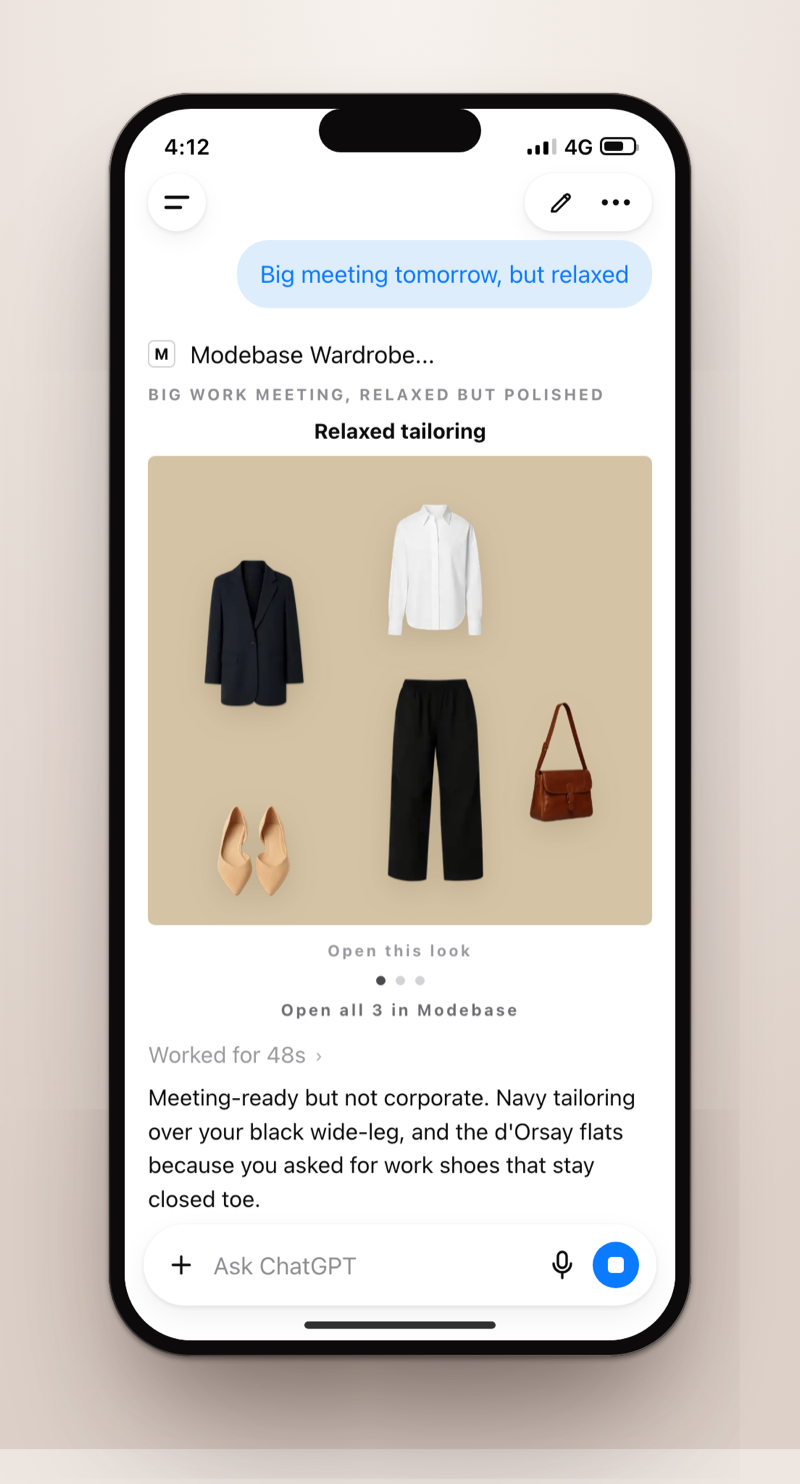
Yes, once it can see them. That is the entire difference a connector makes. It searches your real pieces, builds a look from specific garments, tells you why, and shows it to you.
How do I connect my wardrobe to ChatGPT?
About a minute, on any ChatGPT plan, web or phone.
- In ChatGPT (web or phone), open Settings, then Plugins.
- Search for Modebase and add it.
- Sign in through the popup and allow actions. Allowing actions is what lets it save an outfit, log a wear or remember a preference, so it does not feel stuck.
The full walkthrough, with the Claude version and a troubleshooting list for every way it can go sideways, is on the connect page.
On a plan without plugins? There is a simpler door. Copy your private closet link from your catalogue and paste it into the chat, and ChatGPT can read your wardrobe from that page. It is less capable than the plugin, because it can read but not write back, and it is the fastest way to try the whole idea on any plan.
Then build the wardrobe by talking to it
Here is the part that surprises people, and the reason this does not begin with three lost evenings and a lightbox.
You do not have to catalogue everything first. Drop photos of your clothes straight into the chat, a plain shot, a mirror selfie, a photo of the outfit you wore yesterday, and each piece gets identified and filed. Ask for a fit check on what you are wearing and the pieces in the photo end up in your catalogue while you are reading the feedback.
The wardrobe assembles itself out of things you were doing anyway. Here is the flow, as a demo:
That is one fit check. Do it a handful of times over a fortnight and the catalogue is real, without a single evening spent photographing knitwear against a wall.
What to ask once it is connected
The week, in one go
Plan my work outfits for the week. Three days in the office,
two at home on video calls. It is going to be 14 to 21 degrees.
Do not repeat a piece two days running.
This is the question that changes mornings, because it moves the deciding to Sunday night when you have capacity for it.
Packing
Pack me for five nights in Paris in October. Lots of walking,
two dinners out, one of them smart. Carry-on only. Use only
clothes I own, and tell me which pieces do double duty.
Packing is where a connected wardrobe most obviously beats a chat: it can count, it knows your shoes, and it will not pack around a jacket you do not have. There is a free packing prompt if you want to see the shape of a good answer first.
A capsule, from what you already own
Build me a 12-piece capsule from my wardrobe for spring.
Everything must work with at least three other pieces.
Do not suggest anything to buy.
The last line is the important one. Our capsule wardrobe prompt explains why capsule advice drifts into shopping lists, and how to stop it.
The wedding, the funeral, the thing on Saturday you have been avoiding
Garden wedding, Saturday, 24 degrees, grass underfoot,
I am not in the bridal party. Give me three options from my
wardrobe, ranked, and tell me what each one is saying.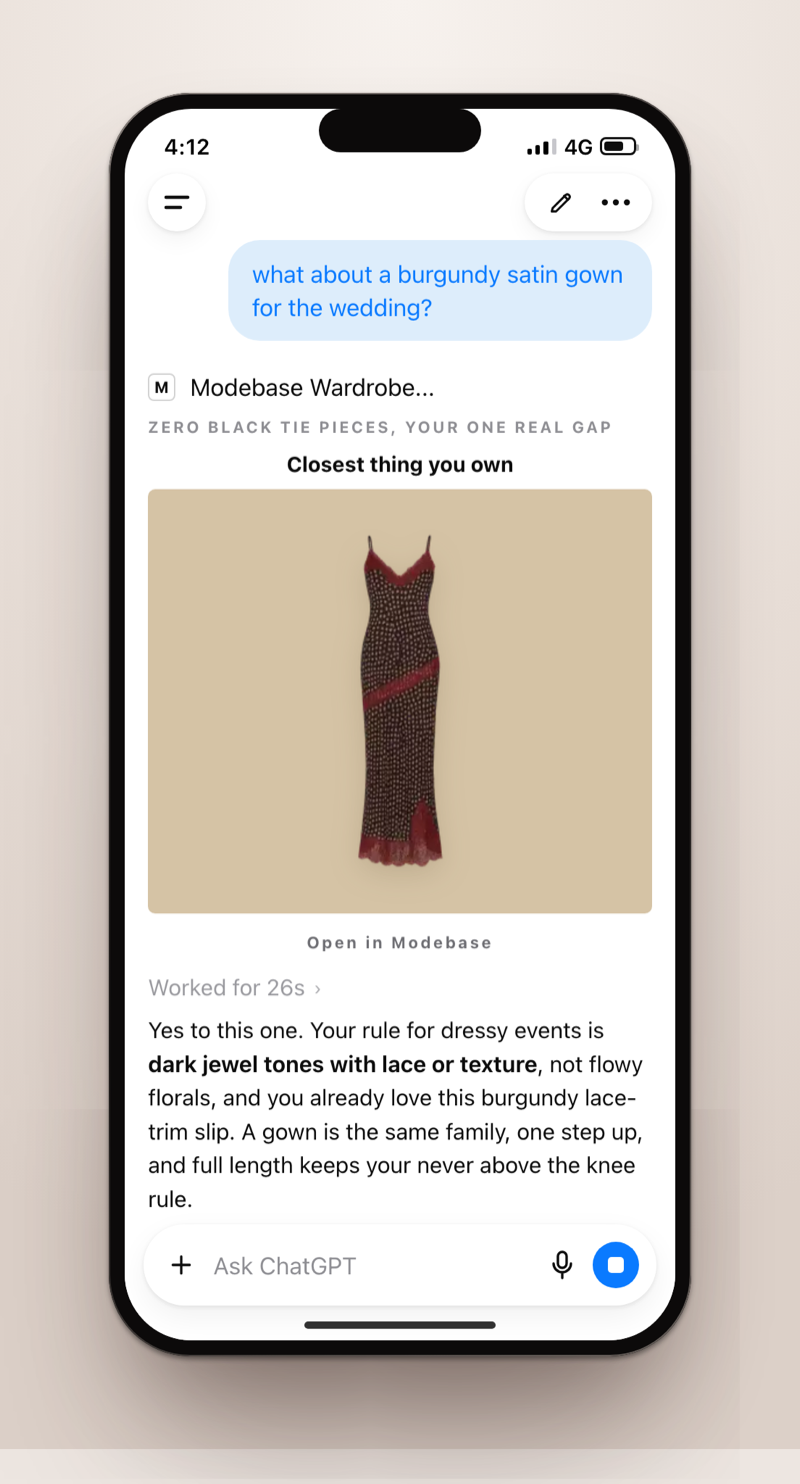
The honest questions
What have I not worn in six months?
What am I repeatedly buying and not wearing? Be blunt.
Which single piece is holding up the most of my outfits?
These only work when something has been keeping count, which is the quiet argument for a wardrobe that lives in a database rather than a chat window. The first honest wear report is usually a small shock. There is a fuller method in the ChatGPT wardrobe audit.
The one you will use most
Does this look right?Photo attached, sent from a bedroom, twenty seconds before leaving. It is the most human thing you can do with any of this.
What it costs
Modebase is free to try. No card, no time limit. That covers creating and planning in your chat with your real clothes, flat lays, capsules with packing lists, shared looks, and a style profile that builds itself as you talk.
If your wardrobe is bigger than that, a membership keeps it growing. Wardrobe is US$9.99 a month, or US$99 a year, and holds up to 500 pieces, adding 50 new ones each month. Collection is US$18 a month, or US$176 a year, and holds up to 2,000, with more added each month plus the deeper wardrobe intelligence and richer detail on every piece. You can cancel anytime. The pricing page has the details.
Is it any good, honestly?
Some straight answers, since the internet is full of the other kind.
It is only as good as your catalogue. Fifteen pieces in, the advice is thin. Sixty pieces in, it is better than most people's own instincts on a Tuesday morning.
It does not know what is in the wash. Or crumpled in a bag in the boot of the car. Tell it, and it works around it.
It has no taste of its own until you correct it. Say "that neckline never works on me" once and it holds on to it, and the suggestions narrow from there.
It cannot want things for you. The beautiful dress you never wear is not a data problem, and no software is going to solve it. Though it will, gently, keep noticing.
The short version of all of it
ChatGPT is very good at using what it is given, and it has never been given your clothes. Everything on this page is one way or another of fixing that.
A list fixes it for an afternoon. A Project fixes it for a small wardrobe, inside one folder. A wardrobe behind the chat fixes it properly, because your clothes become a record: every garment with its detail, its photograph, what you have said about it, what you wore and what you rejected. Ask your question and the assistant works from that rather than from its best recollection of what you once typed.
Which is the whole idea, and it is worth saying plainly. Modebase is not a stylist and does not pretend to be one. It gives ChatGPT the ability to style with you in mind, by handing over your real items and your real style profile. It hands over your real pieces, their photographs, what you have said about each of them and the style profile built from how you actually dress, at the moment you ask. Which is why the answer is about you and your cupboard rather than about clothes in general.
Where to go next
Everything below is part of this guide, split by the question you came with.
Getting your clothes in
- How to upload your wardrobe to ChatGPT. Spreadsheets, photographs and where each one stops.
- Four ways to tell ChatGPT what is in your closet. Ranked by what each costs you.
- The ChatGPT wardrobe inventory template. The free column layout, and the priming prompt.
- How to connect your wardrobe to ChatGPT. Two minutes, and the three things that go wrong.
Asking it things
- How to get ChatGPT to pick your outfit. The version you will actually wear.
- Using ChatGPT as a personal stylist with your own clothes. What to hand it, and what it cannot be.
- ChatGPT as an outfit planner. Plain chat, custom GPTs, Projects and a connected wardrobe, compared.
- The ChatGPT capsule wardrobe prompt. A capsule from what you already own, with no shopping list.
- The ChatGPT wardrobe audit. Find your real gaps before you shop.
What it can and cannot do
- What ChatGPT remembers about your wardrobe. What it holds, and what it will not promise.
- Why not just ask ChatGPT to style you? The complaints people actually have.
- Four writers let ChatGPT dress them. What happened, and what went wrong every time.
Choosing an app
- Wardrobe apps that work with ChatGPT. What the phrase actually means, and who does it.
- What is an AI wardrobe assistant? The category, and the six questions worth asking one.
- The best AI wardrobe apps in 2026. Compared on where the intelligence lives.
Frequently asked questions
Can ChatGPT remember my wardrobe?
Yes, more than people expect. Memory persists until you delete it, and a Project keeps its files and its own memory. The catch is shape: memory is a summary with a capacity limit that condenses and silently drops entries, so it remembers you well and does not hold an inventory.
Can I upload my wardrobe to ChatGPT?
Yes, and a spreadsheet of 150 garments fits comfortably in a Project. What wears it down is that ChatGPT cannot edit an uploaded file in place, so every change is yours to make by hand, and photographs are counted per file, so a photographed wardrobe hits the ceiling fast.
How do I use ChatGPT as a personal stylist?
It is not a stylist and will not replace one. It is very good at applying what it is handed, so hand it the right things: what you own, where you are going and what you have already worn this week. The free stylist and fit check prompts supply the structure, and connecting a real wardrobe means you never describe your clothes again.
Can ChatGPT choose outfits from clothes I own?
Yes, with a wardrobe connector. It searches your actual pieces, builds the outfit from specific garments, shows it as a flat lay and avoids what you wore on Monday, because the wear history sits alongside the clothes.
How do I connect my wardrobe to ChatGPT?
In ChatGPT, open Settings, then Plugins, search for Modebase, and add it. Sign in and allow actions, and you are connected. It works on any ChatGPT plan, including Free, on the web or your phone.
Is there a free way to use my wardrobe with ChatGPT?
Yes. Modebase is free to try with no card and no time limit, and the ChatGPT plugin is available on every plan, including Free, on the web or your phone.
Does this work in Claude?
Yes. In Claude you add Modebase as a custom connector in Settings, then Connectors. Same wardrobe, same outfits, either assistant.