Wardrobe app that works with ChatGPT: 8 options compared (2026)
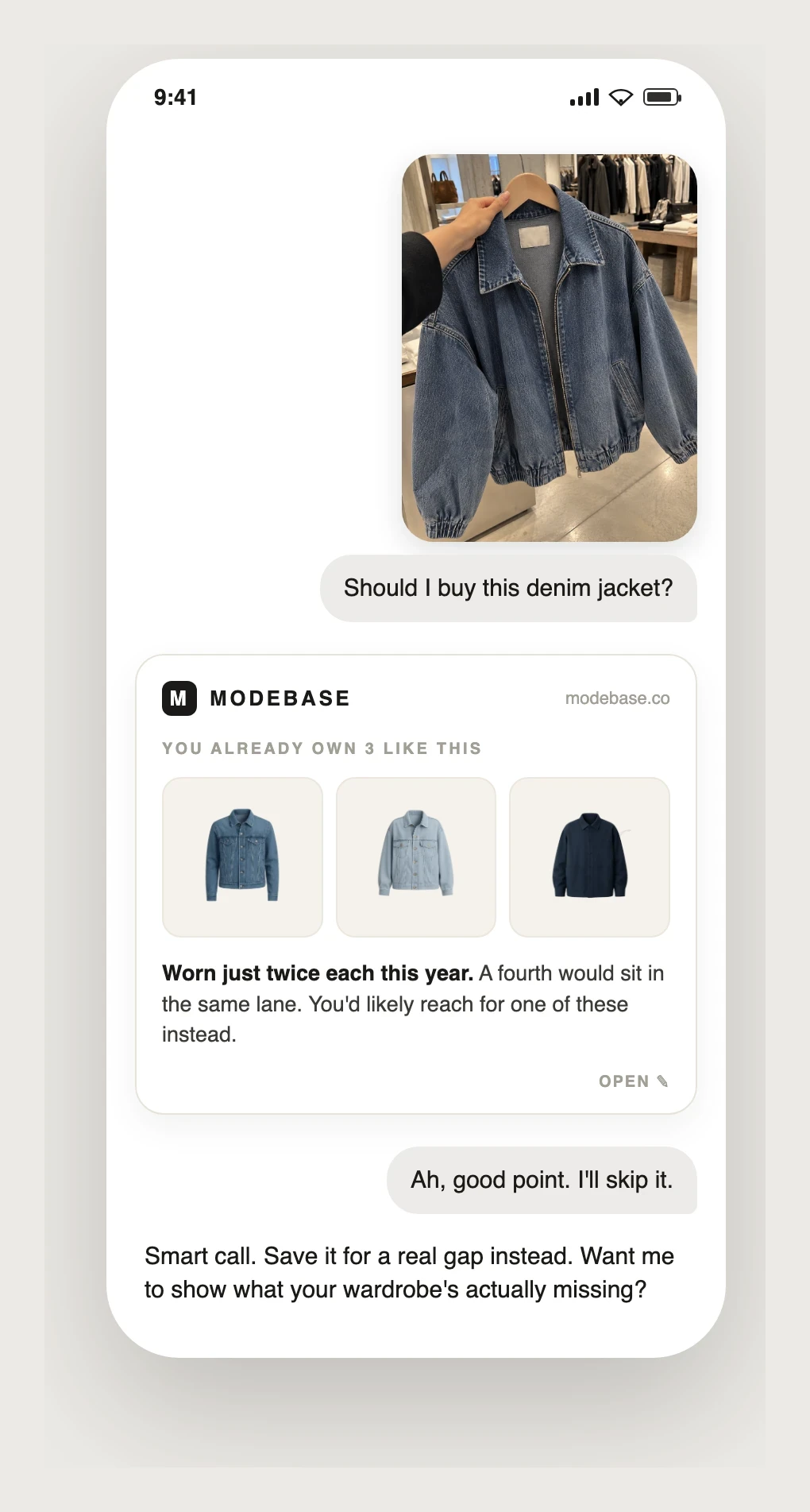
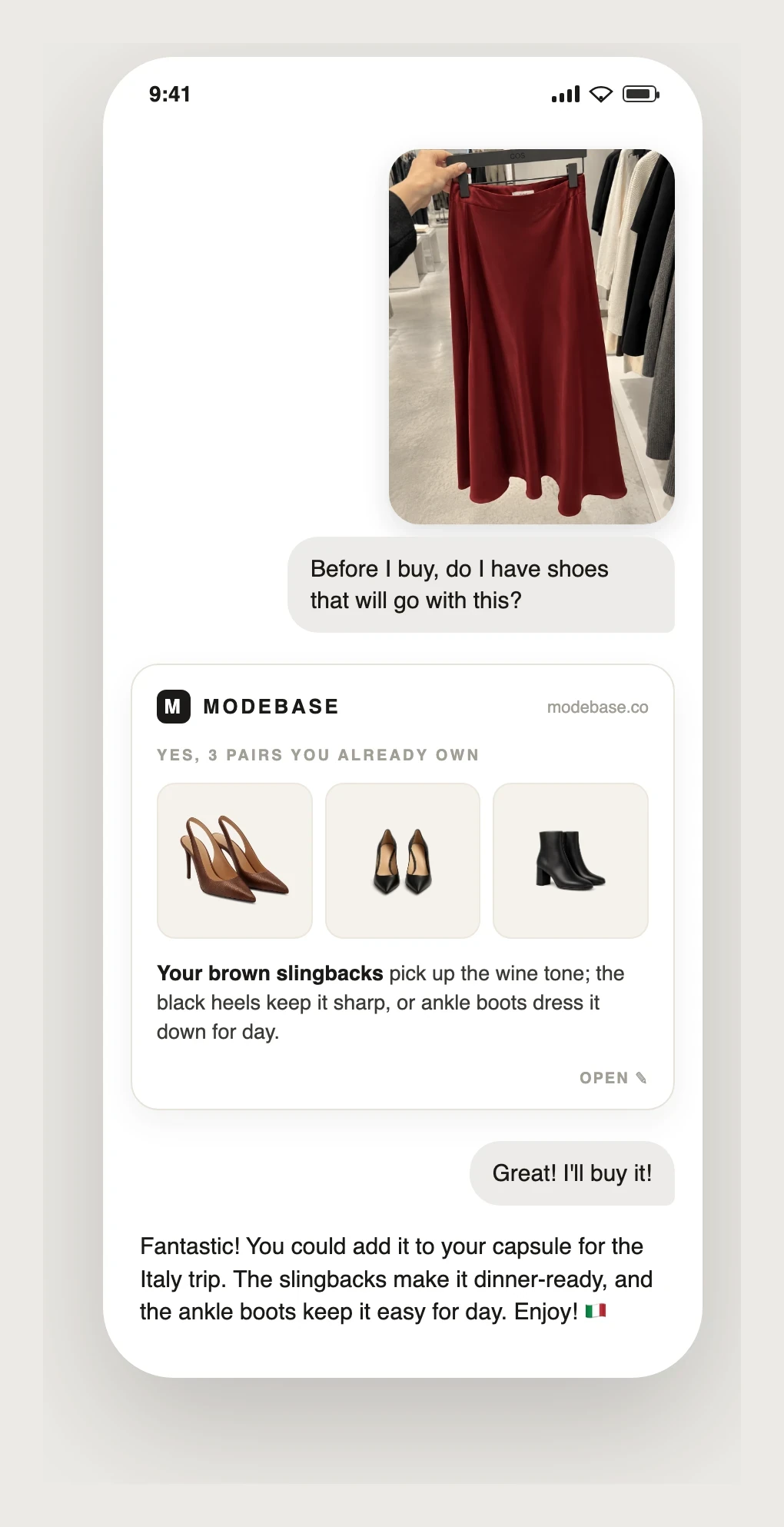
Yes. Modebase is a wardrobe app that connects to ChatGPT directly, so when you ask what to wear, the answer is built from the clothes hanging in your own cupboard, and shown to you as pictures of them.
That is the short version. Here is what it looks like.
What you actually get
Your clothes, held properly. Every piece is a record rather than a phrase: its colour, fabric, cut, how dressy it is, how warm, what it goes with and what it does not. Ask for your navy skirts and you get your navy skirts, whether you own forty pieces or four hundred, because they are looked up rather than remembered. Nothing gets invented, because everything comes out of your own catalogue.
It knows how you have been dressing. Say you wore something and that goes onto the piece. Turn a pairing down and that goes on too, so it stops coming back. Your rules stick: no sneakers to the office, that neckline does not suit you, never the green with the navy.
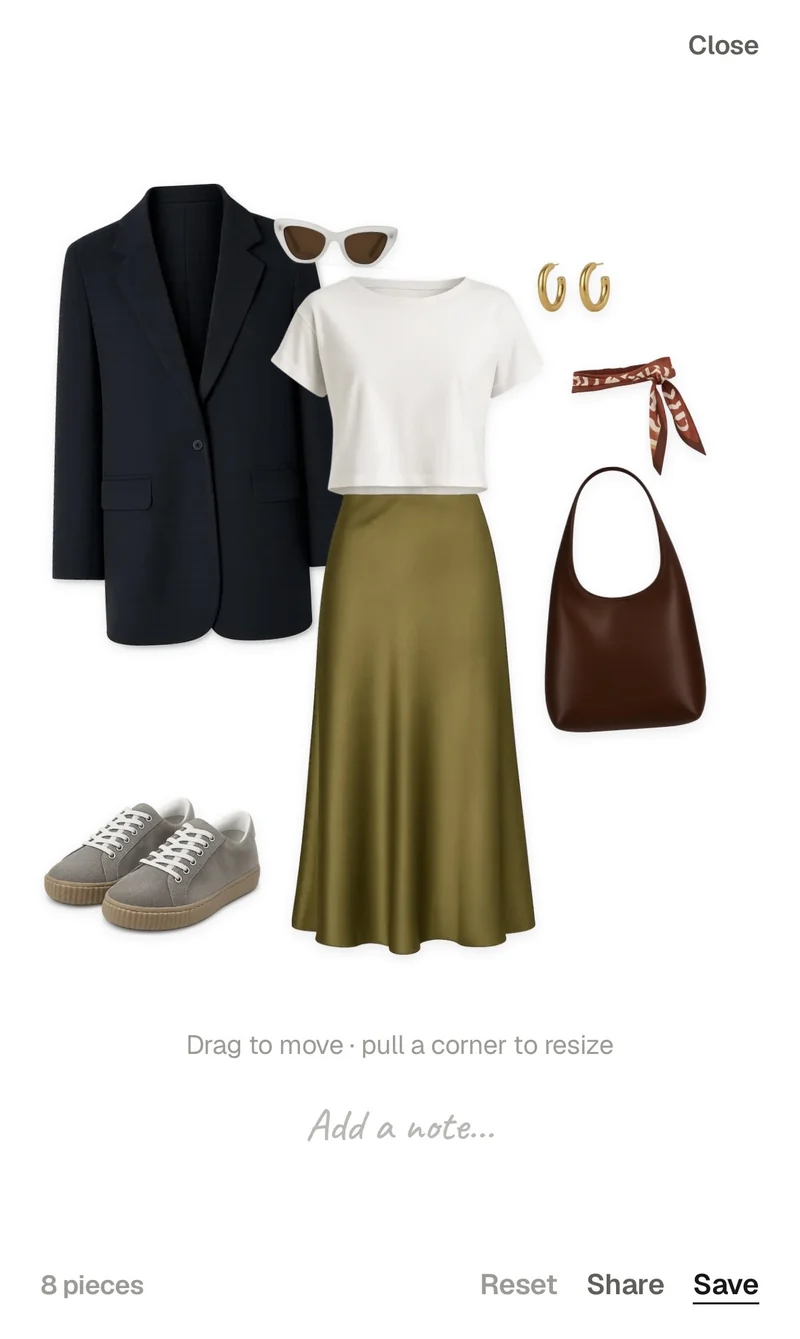
And you can see it. Your pieces come back cut out and laid out together in the chat. Not a paragraph describing a jumper. Your jumper.
Getting your clothes in is not a weekend. Photograph a pile on the bed or a full rail and the separate pieces are pulled out and described for you.
Free to start with 10 catalogue spaces, about two minutes to set up on ChatGPT (any plan, including Free), and it works the same way in Claude. Here is how to connect it.
Where it is weaker, honestly: if you want a polished phone app to browse on the sofa, a human stylist, or resale built in, other apps below do those and Modebase does not. It is a wardrobe your assistant can use, not a social fashion app.
Why most apps cannot do this
Plenty of wardrobe apps say they work with ChatGPT. Almost all of them mean something quite different by it, and the difference is the whole thing, so the rest of this page is how to tell them apart and what the alternatives are genuinely good at.
Disclosure: Modebase publishes this article and is one of the apps in it. We have tried to be straight about where other apps beat us, and there are several places where they do. Where we say a competitor is better at something, we mean it.
The three things people mean by "works with ChatGPT"
Nearly all the confusion here comes from these three being used to mean the same thing. They are not the same thing, and they do not give you the same result.
1. A real connection. The app keeps your wardrobe somewhere ChatGPT can reach. You link the two once. After that, when you ask what to wear, it looks up the actual things you own and answers from those. It can write things down too, so saying you wore the green dress today goes into your records. This is what most people are after, and it is rarer than the marketing suggests. Modebase is the one in this guide that does it.
2. AI inside the app. The app uses AI behind the scenes to suggest outfits in its own screens. Cladwell, for example, says "Powered with ChatGPT" on its site. That is accurate, and it is a good product. It means Cladwell is the one doing the asking, from inside its own app. You cannot open ChatGPT and ask it about your Cladwell wardrobe. Several roundups list this as "ChatGPT integration." It is not the same thing.
3. A custom GPT. Search ChatGPT and you will find dozens: "Wardrobe Wizard", "Virtual Closet Analyzer", "AI Wardrobe Assistant". These are saved instructions with a name. They can hold instructions and a file, but there is no wardrobe behind them: nothing to look things up in, and nothing that knows what you own today. You still have to tell it everything, every time. They are the thing people try first and abandon within a week.
If you take one thing from this page, take that. It is the whole difference between an assistant that guesses and one that knows.
Why you cannot just do this yourself with a file
On paper you could: make a Project, drop in a spreadsheet, done. Plenty of people have tried, and the same three things get them.
It cannot write anything down. This is the wall. It will read your spreadsheet happily, but it cannot tick something off in it. So every time you wear something, buy something or finally let something go, that is you, opening the file and editing it. A chore attached to getting dressed, every single day. Nobody does that twice.
The photographs do not fit. A spreadsheet is one file and that is fine, but photographs are one file each, and a Project holds 5 on Free, 25 on Plus, 40 on Pro. A hundred and fifty garments was never going to fit, so the part you were probably looking forward to, seeing your clothes, is gone before you start.
Memory keeps an impression, not a list. It does remember things about you between conversations, and that part works. What it keeps is a sense of you, and it tidies as it goes. Perfect for "prefers short answers". Not much use for four pairs of black trousers that differ by cut, rise and weight, because that is exactly the kind of detail a tidy-up smooths into "owns several black trousers", and nobody tells you it happened.
It gets harder the more you own. "Show me every navy wool thing I have worn fewer than three times" is a question for something that can count and look up. Handed to a chat as a long block of text, it holds up for a while and then quietly stops being reliable.
A proper connection fixes all of it, because the wardrobe lives somewhere designed to hold it, and the assistant can both read it and write to it.
Quick comparison
| App | Real ChatGPT connector | Also works in Claude | Wear tracking | Cost per wear | Platforms | From |
|---|---|---|---|---|---|---|
| Modebase | Yes | Yes | Yes | Yes | Web, ChatGPT and other AI chats | Free to try |
| Cladwell | No, in-app AI only | No | Yes | Yes | iOS, Android, web | From $4.99/mo |
| Acloset | No, in-app AI only | No | Yes | Yes | iOS, Android | Free to 100 items, from £3.99/mo |
| Whering | No | No | Yes | Yes | iOS, Android, Chrome | Free |
| Indyx | No | No | Yes | Yes | iOS, Android | Free core, $12.99/mo |
| Stylebook | No | No | Yes | Yes | iOS only | $4.99 once |
| Vesta | No, positions against it | No | Yes | Not evidenced | iOS | Free, Pro price unpublished |
| Getwardrobe | No | No | Yes | Yes | iOS, Android, macOS, web | Free to 100 items, $9.99/mo |
Prices checked 16 September 2026 against each app's own site and store listing. They change, so look before you pay.
Apps with AI inside, but no ChatGPT connection
These are good apps. Several are better than Modebase at things Modebase does not do. They just do not put your wardrobe inside ChatGPT, and some marketing copy in this category makes that harder to tell than it should be.
1. Cladwell
Cladwell says "Powered with ChatGPT," and that is honest phrasing for what it is: OpenAI's model working inside Cladwell's own app. You cannot open ChatGPT and ask it about your Cladwell closet.
What Cladwell does better than almost anyone is setup. Instead of photographing everything, you tap your items from a catalogue of roughly fifteen thousand garments, so a closet that would take an evening to shoot takes twenty minutes. If the cataloguing chore is what has defeated you before, start here. Its whole way of thinking about capsules is also the most considered of any app here. Pricing is stated only as under $5 a month.
2. Acloset
The largest of these by user base, with a genuinely capable in-app AI stylist chatbot, virtual try on, personal colour analysis and weather-aware daily suggestions. Free up to 100 items, then tiers from around £3.99 a month. Reviewers consistently note there is no bulk upload, so cataloguing is one garment at a time.
3. Whering
The most generous free full-featured closet available, and the clearest picture of what you actually wear and what you are buying. Cost per wear, wear rate and seasonal reports are all there, plus a Chrome extension and a large item catalogue for faster adding. No connector, but if you want a free, well built digital closet on your phone, Whering is the one to beat.
4. Indyx
Indyx is the outlier, and interestingly so. Its answer to the cataloguing problem is not software, it is people: an Archivist service where somebody comes to your home and digitises your closet, from around $295 for 100 items. Its styling is largely human stylists rather than AI. Membership is $12.99 a month. If you would rather pay to skip the setup entirely and get advice from a person, this is the best option on the list and it is not close.
5. Stylebook
Fourteen years old, iOS only, $4.99 once, no subscription, ever. Its outfit shuffle is randomisation rather than styling, so nobody should buy it for AI. Buy it for the data. Its cost-per-wear and style statistics are the most reliable in the category, and the one-off price means your wardrobe records are not hostage to a subscription. For long-term inventory keeping it remains the sensible choice.
6. Vesta
Worth including because it argues the opposite case, explicitly: its page on the subject says "unlike ChatGPT, Vesta remembers your closet." The critique is fair as far as it goes, and Vesta's answer is to keep everything inside its own app. Getting your clothes in is the cleverest of any app here: it connects to Gmail to pull items from shopping receipts and scanning your camera roll for outfit photos. Pro pricing is not published on its own site.
7. Getwardrobe
The broadest platform coverage here: iOS, Android, macOS and web with sync. Free to 100 items, premium at $9.99 a month or $49.99 a year, plus a professional tier at $69.99 a month for stylists managing clients. Solid, unglamorous, works everywhere.
What about custom GPTs?
Skip them. "Wardrobe Wizard", "Virtual Closet Analyzer", "AI Wardrobe Assistant" and the rest are prompts with a name. They can carry instructions and a knowledge file, which is not nothing, but there is no wardrobe behind them: nothing to look things up in, nothing that changes when you wear something, nothing that knows what you own today rather than on the day the file was written. Every one of them requires you to describe your clothes in the chat, which is the exact problem you were trying to solve. They are not apps and they are not connectors.
How to choose
You want ChatGPT to know your actual clothes. Modebase, which is the only one in this guide that does. A couple of smaller apps outside it are building the same thing, so look around if none of these suit you.
You want a smart wardrobe you can use anywhere. Modebase.
You hate photographing things. Cladwell, or Vesta for its receipt import, or pay Indyx to do it for you.
You want free and good. Whering.
You want to own your data forever with no subscription. Stylebook.
You want a human being to help. Indyx.
Setting up a wardrobe connector
The process is much the same wherever you go.
- Create an account with the wardrobe app and catalogue your pieces. This is the part that takes effort and the part that determines whether any of it works. Do the things you actually wear first.
- In ChatGPT, open Settings, then Plugins, find the app, and add it. Some wardrobe apps are added this way; others still ask you to paste a connector URL.
- Authorise the connection with your account.
- Ask it something real. "What should I wear to dinner on Thursday, it is going to be about 18 degrees" is a better first test than "show me my wardrobe," because it tells you immediately whether the thing is reasoning from your clothes or making things up.
The same connector generally works in Claude as well, since both use the same underlying standard.
If you want the fuller picture of what changes once a wardrobe is connected, start with using your wardrobe with ChatGPT.
Frequently asked questions
Can ChatGPT remember my wardrobe on its own?
Not reliably. Saved memory is designed to hold preferences, and it can combine or rewrite entries by itself, which is fine for "prefers concise answers" and destructive for a list of 150 specific garments. Project files hold more, but ChatGPT cannot update them in place, so keeping them current means regenerating and re-uploading the file every time anything changes.
Is there a free wardrobe app that works with ChatGPT?
Modebase is free to try, with no card. Beyond that, Wardrobe at US$9.99 a month holds up to 500 pieces and Collection at US$24.99 a month holds up to 1,000. See the pricing page for the details.
What is the difference between an app that uses ChatGPT and one that connects to it?
An app that uses ChatGPT calls the model from inside its own interface, so you get AI outfit suggestions in that app. An app that connects to ChatGPT lets the assistant reach into your wardrobe, so you get answers about your real clothes in the chat you already use. Only the second one lets you ask ChatGPT directly.
Do I have to photograph every item?
For most apps, yes, and it is the reason most people give up. Cladwell lets you tap items from a catalogue instead. Vesta imports from your shopping receipts through Gmail. Indyx will send a person to do it. Whichever route you take, start with the things you wear every week rather than trying to do the whole cupboard in one sitting.
Modebase takes the work out of it another way: it pulls the individual pieces out of the photos you already have and files them for you. No weekend cataloguing session to set aside.
Does this work with Claude too?
Yes for the connector-based apps. Connectors are built on an open standard, so the same wardrobe generally works in Claude and in ChatGPT.
Is my wardrobe data private?
It depends on the app, so read the policy rather than the marketing. The question worth asking is whether your photos and item data are used to train models, and whether you can delete everything on request.
The bottom line
Most wardrobe apps do not work with ChatGPT. A few use AI internally and describe it in ways that sound like they do. Of the apps in this guide, Modebase is the one with a genuine connector. The category moves quickly, so it is worth checking whether that is still true by the time you read this.
Whichever you choose, the thing that determines whether it works is not the AI. It is whether you get your clothes into it and keep them there. An assistant with an accurate picture of 120 garments will beat a better assistant with a vague picture of 40 every time.