What is an AI wardrobe assistant? And what can it actually do?
My mother kept her wardrobe in her head. She could tell you, at any hour, that the green dress needed a hem, that the good coat was at the dry cleaner, and that you had worn the blue twice to the same family thing so perhaps not again. She was an excellent wardrobe assistant. She was also, it must be said, unsolicited.
An AI wardrobe assistant is the polite software version. It knows what you own, it remembers what you have worn, and it answers when asked. The term has been attached to about four different kinds of product in the last two years, though, so it is worth sorting out what it actually means before deciding whether you want one.
Four generations, in the order they arrived
The digital closet. A photo album of your clothes with categories. Useful for seeing what you own when you are not at home, and not much else. You still do all the thinking.
The wardrobe app. The closet plus planning: outfits you build and save, a calendar, packing lists, and eventually wear tracking and cost per wear. This is where most of the category still sits. The app is capable, and it is entirely reactive: it holds what you put in and shows you what you ask for.
The AI wardrobe assistant. The app starts suggesting. It reads the weather, notices you have worn that three times this week, generates combinations you would not have assembled yourself. Good ones feel like a second opinion. The catch is that the second opinion is only available inside that app, which means asking requires opening it, which means most days you do not ask.
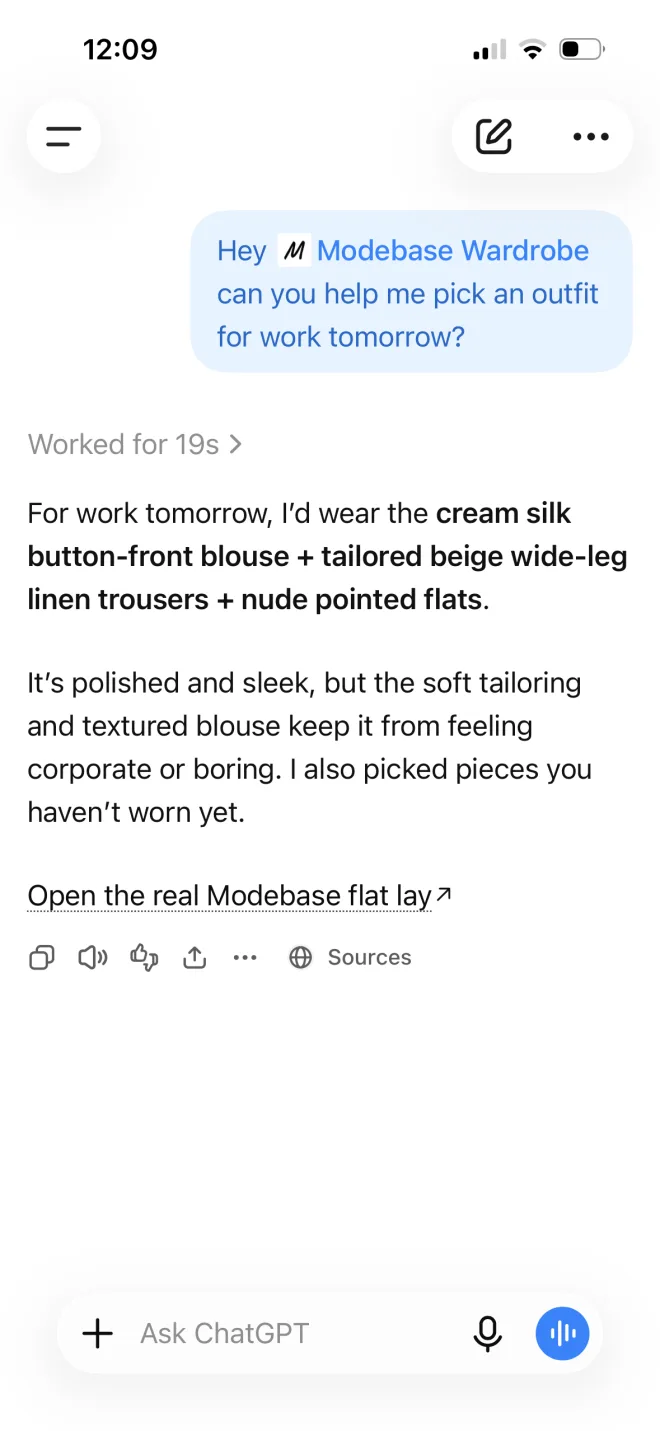
The AI-accessible wardrobe. The newest of the four, and the one that inverts the arrangement. Instead of the intelligence living in the wardrobe app, your wardrobe becomes something the assistant you already use can read. You do not go to your clothes. Your clothes are available wherever you are already asking questions.
The distinction is not marketing. It decides whether you use the thing on a Tuesday.
What a good one can actually do
Here is the honest list, with the prompts, because "AI-powered styling" means nothing until you see the question and the answer.
Every one of them rests on the same thing: the assistant being able to see your actual clothes. That is the part Modebase does, by handing over your real pieces and your real style profile the moment you ask.
"Dress me for work tomorrow"
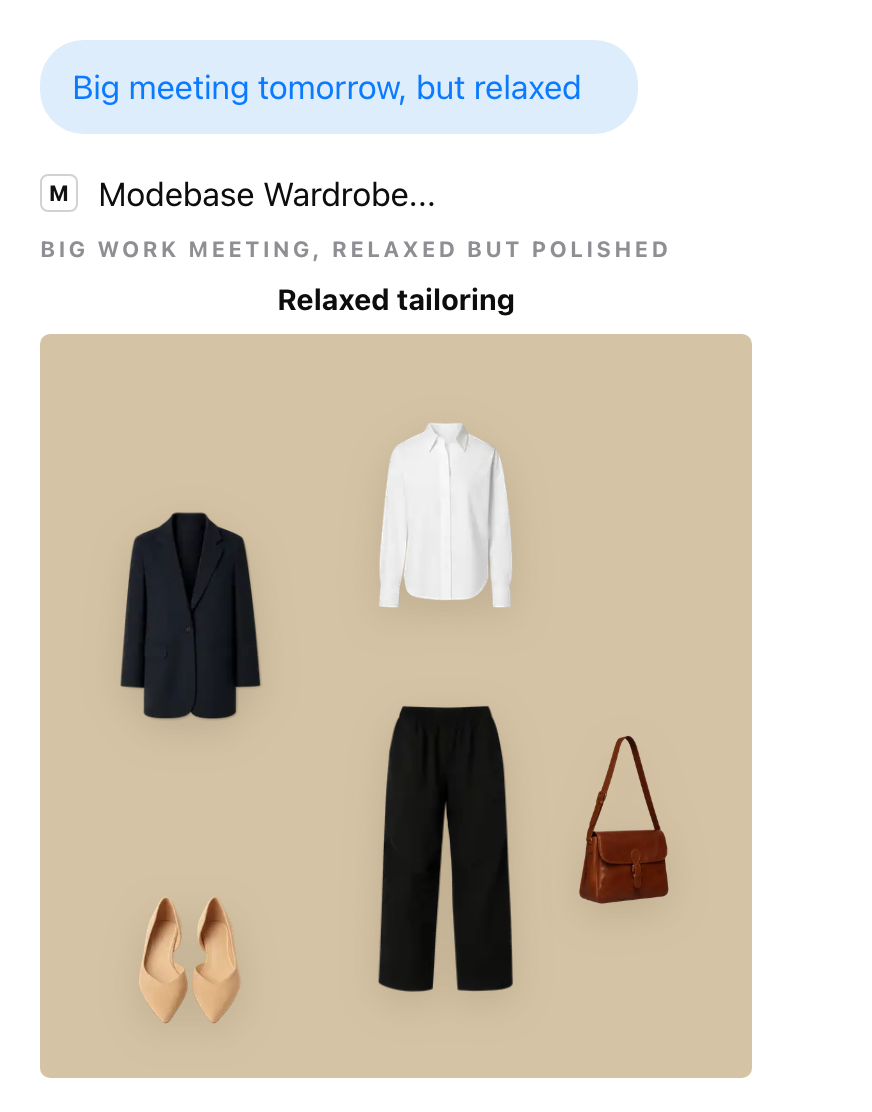
The everyday one. A useful answer names specific garments you own, accounts for the weather where you actually live, avoids what you wore on Monday, and gives one line of reasoning so you can disagree with it. A useless answer describes a capsule wardrobe in the abstract and recommends a trench coat.
What should I wear to work tomorrow? Office, about 18 degrees,
I have a client meeting at 2 but nothing formal. Not the black
trousers, I wore them Monday.
"Pack me for Paris"
Packing is where an assistant earns its keep, because it is a puzzle, and people are bad at puzzles with a suitcase open on the bed at eleven at night. The test of a good answer is whether every piece it lists works in at least two of the outfits, and whether it has counted the shoes. Shoes are always where a packing list quietly falls apart.
Pack me for five nights in Paris in October. Lots of walking,
two nice dinners, one of them smart. Carry-on only. Use only
clothes I own and tell me which pieces do double duty.
"Build me a capsule from what I already have"
The version worth having builds the capsule from your existing clothes and does not attach a shopping list. If the answer starts with things to buy, it has not understood the question. Our capsule wardrobe prompt has the wording that keeps it honest.
"What have I not worn?"
This is the question that changes behaviour, and it only works if something has been keeping count. Not your estimate of what you wear. The count.
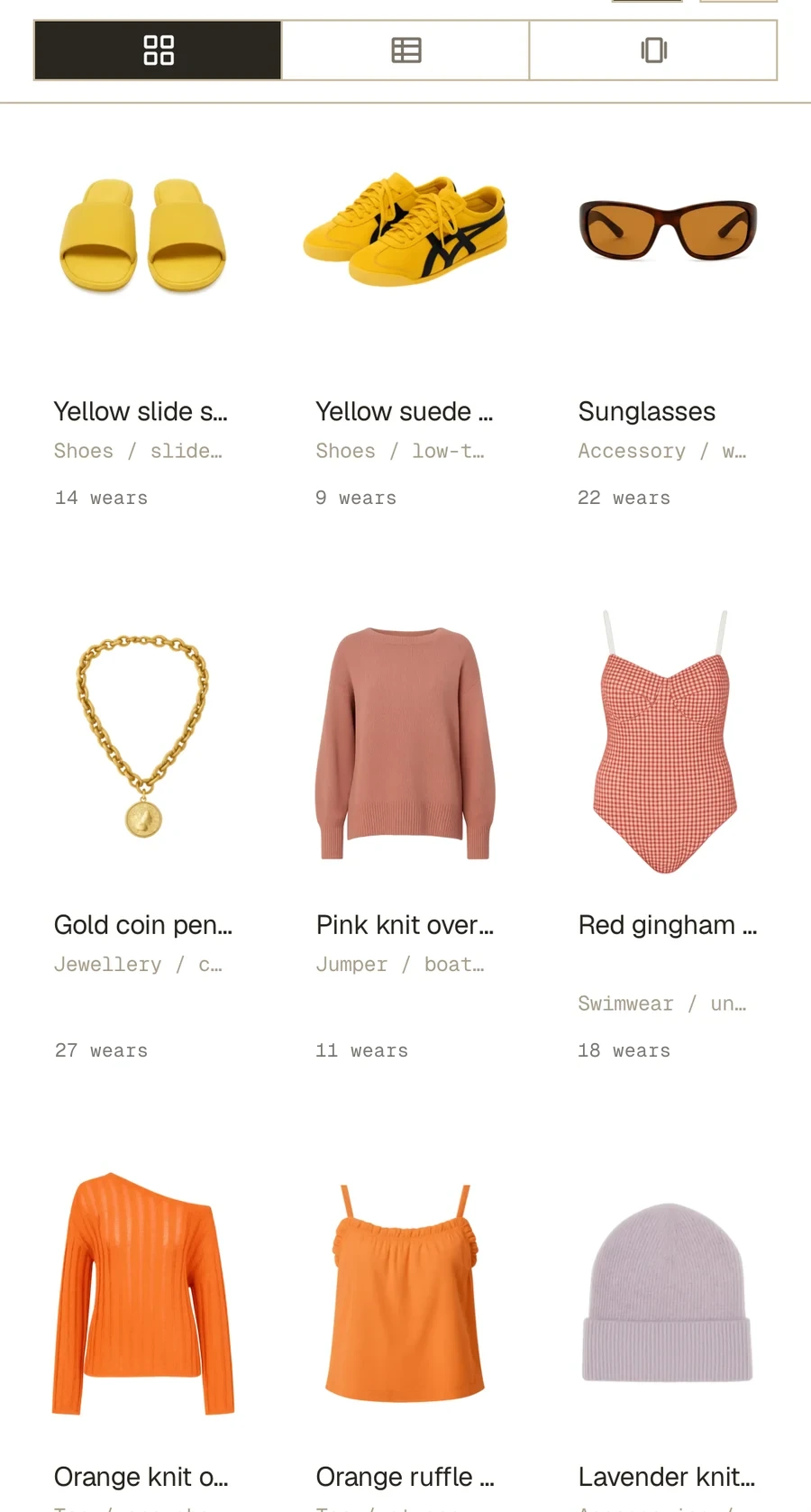
Almost everybody's first honest wear report is a small shock. The pieces you think of as your favourites are often worn less than the boring reliable ones, and there is usually an entire category, something like "the going-out clothes", that has not moved in a year.
"What should I stop buying?"
The most useful question in the whole list, and the one no shopping app will ever ask on your behalf. With a real wear history behind it, the answer is specific and slightly painful: you own six striped tops and wear two, you buy jackets in April and wear them in July, the third pair of ankle boots has never left the cupboard.
Looking at what I own and what I actually wear, what am I
repeatedly buying that I do not wear? Be blunt.
"Does this look right?"
A fit check. Send a photo of the outfit you have on and ask for an honest read on proportion, colour and whether the shoe is fighting the trouser. It is the one thing in this list that works even with no wardrobe data at all, which is why it makes such a good first test. There is a free fit check prompt if you want to try it before committing to anything.
What it cannot do, and beware anyone who says otherwise
- It cannot see how a thing fits you unless you show it. Measurements and photographs help. Adjectives do not.
- It does not know what is in the wash, or crumpled at the bottom of a bag, unless you tell it.
- It has no taste of its own. It has an average of everyone's taste, which is a different and much duller thing, until you correct it enough times for your preferences to stick.
- It cannot want things for you. The dress you love and never wear is not a data problem, and no assistant is going to resolve it.
The right expectation is a very well-informed friend who has an excellent memory, no opinions about your life choices, and unlimited patience for the question "but what about with the boots".
How to get one
Two routes, and they suit different people.
Inside a wardrobe app. Acloset and Cladwell are the strongest here. You catalogue in the app, and the assistant lives in the app. Best if you enjoy the app itself and will open it.
Attached to the assistant you already use. Your wardrobe becomes data ChatGPT or Claude can read, so the styling happens in the chat you already have open. This is what Modebase does, and the setup is about two minutes: connect it once, then build the catalogue by dropping photos of your clothes into the chat, or by asking for a fit check on the outfit you are wearing and letting it file the pieces for you.
The full walkthrough, including what to ask it once it is connected, is in how to use your real clothes with ChatGPT.
Frequently asked questions
What is an AI wardrobe assistant?
Software that knows the clothes you own and helps you decide what to wear with them. The useful versions hold a real catalogue of your garments and a record of what you have worn, then answer questions such as what to wear tomorrow, what to pack, and what you have not worn in six months.
Is an AI wardrobe assistant the same as a wardrobe app?
No. A wardrobe app stores and organises. An assistant suggests and remembers. The newest kind does not live in an app at all: your wardrobe becomes data that ChatGPT or Claude can read, so you ask in the chat you already use.
Can an AI stylist work with the clothes I already own?
Only if it can see them. Given a real catalogue it will build outfits from specific pieces you own. Without one it is describing clothes in general, which is why so much of the advice reads like a shopping list. Worth saying plainly: none of this replaces a stylist. A stylist brings the eye and the structure. Software applies what it has been handed, and cannot invent that part.
Is an AI wardrobe assistant worth it?
If you get dressed most mornings with a vague sense of dread, or you keep buying the same thing, yes. If you wear a uniform and like it, no. The value is proportional to how many decisions your wardrobe asks of you each week.
Is my wardrobe data private?
It should be yours, exportable, and deletable. Ask that question of any app before you spend three evenings filling it, because the answer is the difference between a record you keep and a record you rent.