Four writers let ChatGPT dress them. The same thing went wrong every time.
There is a whole genre of article now and it always goes the same way. A writer hands her week over to ChatGPT, photographs herself every morning, and reports back on Sunday with a verdict. Some of them are delighted. One of them gave up and went back to Pinterest. One built a small piece of software.
We read four of them properly, start to finish, because the interesting part is not the verdict. It is the bit in the middle that every one of them describes and none of them quite names: the amount of her own time each writer spent telling a computer what was hanging in her own wardrobe, and the things it got wrong anyway, because she could never tell it everything.
The short version
Three magazines and one very determined engineer. In all four, the styling advice was fine. What went wrong went wrong for the same reason every time, and it was never the model being stupid. It was the model being told almost nothing.
The week that mostly worked
Amanda Gunn, for Fashion Journal. First published in May 2023 and still doing the rounds, which tells you how well the format travels.
She gave it the weather, a handful of pieces she wanted to wear, five celebrities she likes the look of, and asked for the week in a table. What came back on the first pass included pointed-toe flats, a black turtleneck dress and a statement belt, none of which she owns. She corrected it.
Then she asked it to do accessories, hair and makeup too, and it reached again for the statement belt, plus a chunky gold bracelet and a knit beanie. So she sat down and typed out every bag she owns, one by one, navy, yellow, green, purple, amber, black, white and a cow-print one, and then all three of her scarves.
By Friday she was quietly doing the substitutions herself. No striped t-shirt, but a striped long-sleeve, so she wore that. The denim jacket it suggested looked wrong on, so she swapped it for the beige one.
Saturday is the one worth pausing on. It sent her out to run errands with the cow-print bag, which turns out to be tiny. She swapped it for a tote and was generous about it in the write-up: it didn't know the bag was so small.
No, it didn't. And it never would have, because there is nowhere for that to live. The size of a bag is a fact about the bag, and she had no way of attaching it to the bag.
She finished the week happy. It reminded her of things she had forgotten she owned and gave her new ways to wear pieces she finds difficult. The prompts she says she wants next are the tell: three looks to wear with her purple bag, different ways to style her beige denim jacket. Both of those are questions about a specific object. You cannot really ask them of a conversation that has never seen the object.
The week that did not work
Rebecca Mitchell, for ELLE Australia, June 2023. She was thorough. She gave it her age, her job, her city, the temperature range, and asked for Monday to Friday including shoes.
What she did not give it, because honestly who would, was a list of what she owns. Back came a tailored blazer, a white blouse, high-waisted black trousers and black pumps. She wore her own approximations: a grey blazer, a cream button-up, black lace-ups.
She asked for something trendier. It produced mustard trousers, floral skirts, chunky heels and a jumpsuit, and she had to write back and explain that she does not own a jumpsuit.
Her conclusion was that in the time she spent coaxing it toward the clothes she actually had, she could have put on trousers and a blouse and spent the twenty minutes in bed. She would rather use Pinterest.
She is not wrong, and the advice was not bad. It simply was not hers, and making it hers was the entire job.
The professional, unimpressed
Erin Fitzpatrick, for Who What Wear, February 2026. Fifteen years a fashion editor, and she asked it for the pieces worth investing in this year.
It gave her a tailored black blazer, a camel coat, simple sneakers, the perfect white t-shirt, straight-leg jeans, minimalist pumps, good gold jewellery and low-key sunglasses. Its reasons were versatility, cost per wear and ease.
Her objection is not that the list is wrong. It is that it could have been written in 2006, that it knows nothing about what is happening in the world this year, and that not one item on it would make you feel anything at all.
It is worth sitting with, because that list is the failure state of every wardrobe question asked cold. Given nothing to go on, a model returns the average of everybody. The average of everybody is a camel coat.
The one who engineered her way out
Arielle Caron, on Medium, January 2025. Thirteen minutes long and worth all of them, because she did not give up, she built her way through.
Her setup: photograph everything, have one model write a full description of each garment, have a second one squash each description down to a single line and give it a code, SH010 for a shoe, TP022 for a top. All of it goes into one inventory file, and a custom GPT she named Pico Glitter does the styling by reading that file.
Then she had to solve the problems that came with it. The inventory file was being quietly cut off before the model ever saw the end of it. She worked this out by writing her dog's name at the very bottom of the file and then asking what her dog is called. If it did not know, the file had been trimmed, and she moved the line up until it found it, which told her exactly where the cut fell.
Long conversations brought the other problem. The suggestions narrowed to the same few things, item codes came back garbled, and it started inventing outfits out of nothing. Turquoise cargo pants with lavender clogs. Her fix was to tell it to go back and re-read her inventory, or to start again in a fresh chat.
And it worked, genuinely. She cleared out more than fifty bags of clothes she never wore. Getting dressed went from half an hour or an hour of trial and error down to three or four minutes.
It is the most impressive of the four and also the most damning. She built a wardrobe database, an item coding scheme, a summarising step and a re-reading habit, all by hand, and she still had to remind the thing to look at her own closet. When she landed on an outfit she loved, she pasted it into her Notes app with a tag, because there was nowhere else for it to go.
The same four problems, every time
Read together, the pattern is almost comically consistent.
| What went wrong | Who ran into it | What was actually missing |
|---|---|---|
| It suggested clothes she does not own | All four | Nothing had ever told it what she owns |
| She typed out her wardrobe by hand | Gunn, Caron, and Mitchell gave up before she got there | Somewhere for the wardrobe to live that is not a message |
| It narrowed, forgot, or invented | Gunn, Caron | A list pasted into a chat is only in that chat |
| It could not know the small true thing | Gunn, and the bag that holds nothing | Detail attached to the individual piece |
| The good outfits went nowhere | Caron, into a Notes app | A record that keeps what worked |
Not one of those is a problem with the styling. Every one of them is a problem with the wardrobe, or rather with the fact that there wasn't one.
What all four of them were missing
A Modebase wardrobe is the piece none of them had. It is more than an app. It holds your real clothes, the detail on every single one, and the way you actually dress, and it hands all of that over the moment you ask, in the chat you were already using.
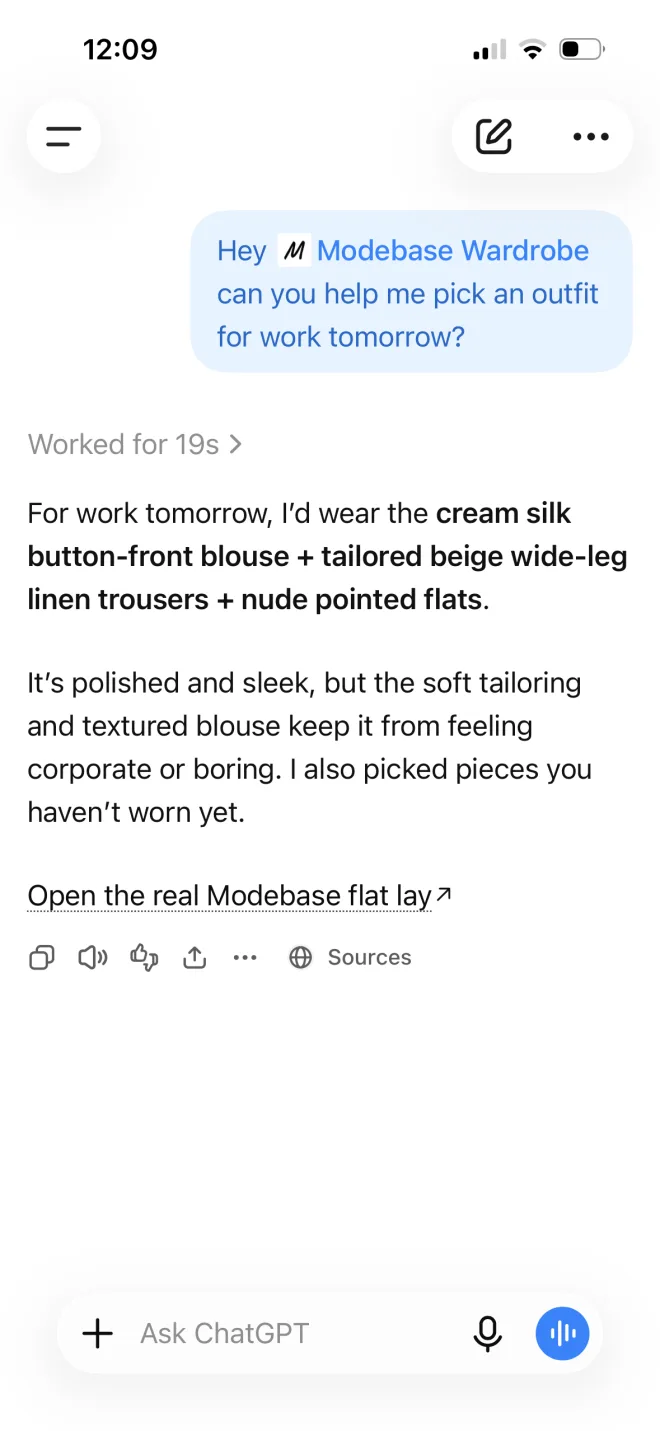
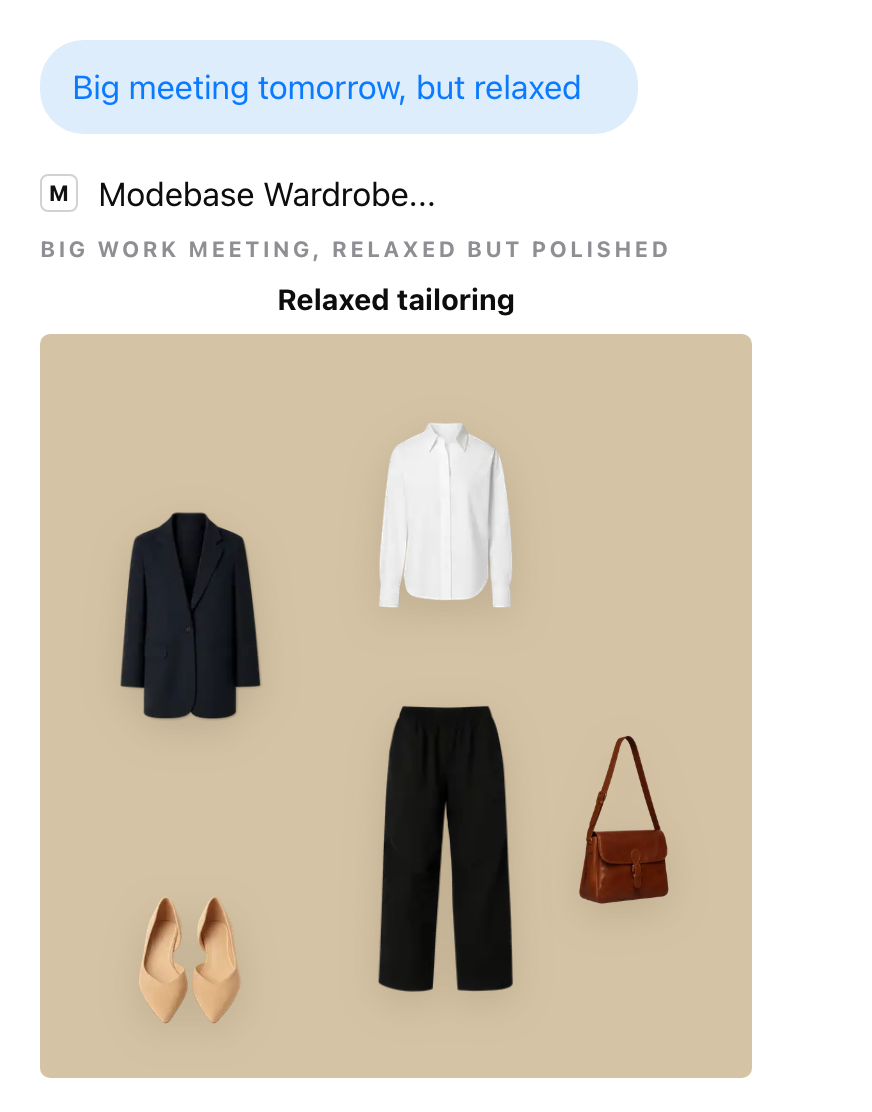
Your clothes get in without a weekend of typing. Photograph a pile on the bed or a full rail and the separate pieces are pulled out and described for you. Or build it as you go, by taking a fit check on your way out the door. Nobody writes a line per garment. Nobody invents an item code.
You can see them. Every piece is cut out on a clean background, and when you ask about your navy skirts, your navy skirts appear in the chat as pictures. Amanda Gunn photographed herself every day for a week to see how the outfits looked. That part can happen before you get dressed.
The small true thing lives on the piece. The cow-print bag barely holds a phone. Say that once and it is saved onto that bag, so it comes back every time that bag is considered, this Saturday and in two years. Too long without a heel. Only ever with flats. I feel wonderful in this. None of that has to be remembered by anybody, because it is written down where it belongs.
It knows the rest of what is going on. The weather where you actually are, what is in your calendar, the trip you are packing for. So the question can be what do I wear on Thursday, rather than a paragraph of context typed out again from scratch.
And the good ones stay. Save the outfit, build a lookbook, pull together a capsule, ask for an honest audit of what you own, flag the things you are finished with for resale. All of it in the same conversation, all of it against your real wardrobe. Not a Notes app.
The profile gets better as you go, too, because what you say about your clothes goes back into the wardrobe instead of vanishing when you close the tab. That is the difference between advice for someone your size and styling for you.
Four writers, four experiments, and the same missing thing every time. Not a cleverer model. A wardrobe.
Amanda Gunn wanted three looks to wear with her purple bag. That is a one-line question when the bag is in a Modebase wardrobe, with its photograph, and the note that it does not fit anything. If you want to see what that looks like before you try it, start with using your wardrobe with ChatGPT.
Frequently asked questions
Can ChatGPT be your stylist?
No, and nothing in these four weeks suggests otherwise. It cannot replace a stylist, because it cannot come up with the structure a stylist brings: the eye, the rules for your body and your life, the willingness to say no to you. What it can do, and does well, is take knowledge it has been given and apply it consistently at ten to eight in the morning. Hand it your real clothes, your real style profile, and better still a stylist's structure to work within, and it is properly useful. Hand it nothing and you get a camel coat.
Why does it keep suggesting clothes I do not own?
Because it has not been told what you own, and it will fill a gap rather than admit to one. Every writer here hit it: a jumpsuit, a statement belt, pointed-toe flats, a striped t-shirt. The fix is not a better prompt, it is giving it the actual wardrobe to work from.
Do I have to type my whole wardrobe into the chat?
That is what these writers had to do, and it is why two of them stopped. You do not have to. A Modebase wardrobe is built from photographs of your clothes and read straight from the chat, so the list is never typed and never pasted.
Would a custom GPT or a Project fix it?
They help, and Arielle Caron's write-up is the best account anywhere of how far you can get. She still had to catch her own file being silently cut short, tell it to re-read her closet, and keep her finished outfits in a Notes app. It is a lot of engineering to end up with a wardrobe that cannot count.
What did the four of them conclude?
Two enjoyed it and would do it again as inspiration rather than instruction. One decided her time was better spent on Pinterest. One built a multi-step system, cleared fifty bags of clothes out of her house, and cut her getting-dressed time to about four minutes. The gap between those outcomes is almost entirely how much of her wardrobe each one managed to get in front of it.