How to upload your wardrobe to ChatGPT
Yes, you can upload your wardrobe to ChatGPT. The more useful question is what happens to it afterwards, because "uploaded" and "being used" turn out to be two quite different states, and the gap between them is where people lose an evening.
Here is each way of getting your clothes in, what it actually costs you, and the point at which each one lets you down.
The short version
A spreadsheet is the best thing to upload, and it works better in a Project than in a single chat. Photographs are the thing people most want to upload and the thing that works least well, because they are counted per file and a wardrobe is a lot of files. And every uploaded wardrobe has the same expiry date: the moment you buy a coat, the file is wrong and nothing tells you.
Uploading a spreadsheet, which is the one that works
ChatGPT will happily open a CSV or an XLSX and work through it. Put it in a Project and it stays there for every chat in that project, so you are not re-uploading on Tuesday what you uploaded on Monday.
Two things decide whether it is any good.
How you describe each piece. This matters more than anything else on this page. Silk shirt, ivory, dressy, works for the office, dinner or a wedding gets found when you ask about a wedding. Ivory shirt mostly does not, because there is nothing in it to match against. The column layout in the wardrobe inventory template is built for this and is free.
How big it is. With a long file it tends to go looking for the relevant rows rather than reading every one. That is exactly right for a contract and wrong for a wardrobe, where a good outfit needs all of it considered. Ask about a wedding and it finds your dresses and your good heels, and the ivory shirt you think of as workwear, the one that would actually have worked, never surfaces.
So: keep it tight, describe each piece properly, and for an important question paste the relevant rows straight into the chat as text rather than relying on the file.
Uploading photographs, which is the one people want
You can upload a photo of a garment and ChatGPT will describe it well. You can upload a photo of a full rail and it will have a decent go at listing what it sees.
What you cannot do is upload your wardrobe as photographs and expect to have a wardrobe. Files are counted per upload, a photographed wardrobe is a hundred and fifty files, and you will hit the ceiling long before you hit the end of your cupboard. Even where it fits, the chat is working from its description of the photo, not from the photo, so asking it later to show you the navy skirt gets you a sentence rather than a skirt.
The genuinely good use of a photograph is the one nobody thinks of: upload a photo of the pieces you cannot describe, and ask it to write the spreadsheet row for you. Then use the words. That converts the thing photos are good at into the thing files are good at.
Typing it straight into the chat
Unfashionable and often correct. For one outfit today, the thirty things you would actually consider beats everything you own, and you can see exactly what it can see, because it is right there on the screen. Nothing is being half read and nothing is being summarised.
It falls over on repetition. You will do it again tomorrow, and the day after, and by Thursday you will stop.
The thing every uploaded wardrobe has in common
It is a photograph of your wardrobe on the day you made it.
You buy a coat. You finally let the jeans go. You take a hem up. The file has no idea, and it will not tell you it has gone stale, it will just quietly answer from a cupboard you no longer have. Keeping it true is a job, and it is a job that lands on you, on a Sunday, when you would rather not.
It also cannot hold anything you learn. You discover the bag is too small to be useful, or that the trousers only work with a heel, or that you feel wonderful in the green. In an uploaded file there is nowhere for any of that to live except a cell you would have to remember to go and edit.
Not uploading it at all
The alternative is to stop uploading and let the chat look things up instead.
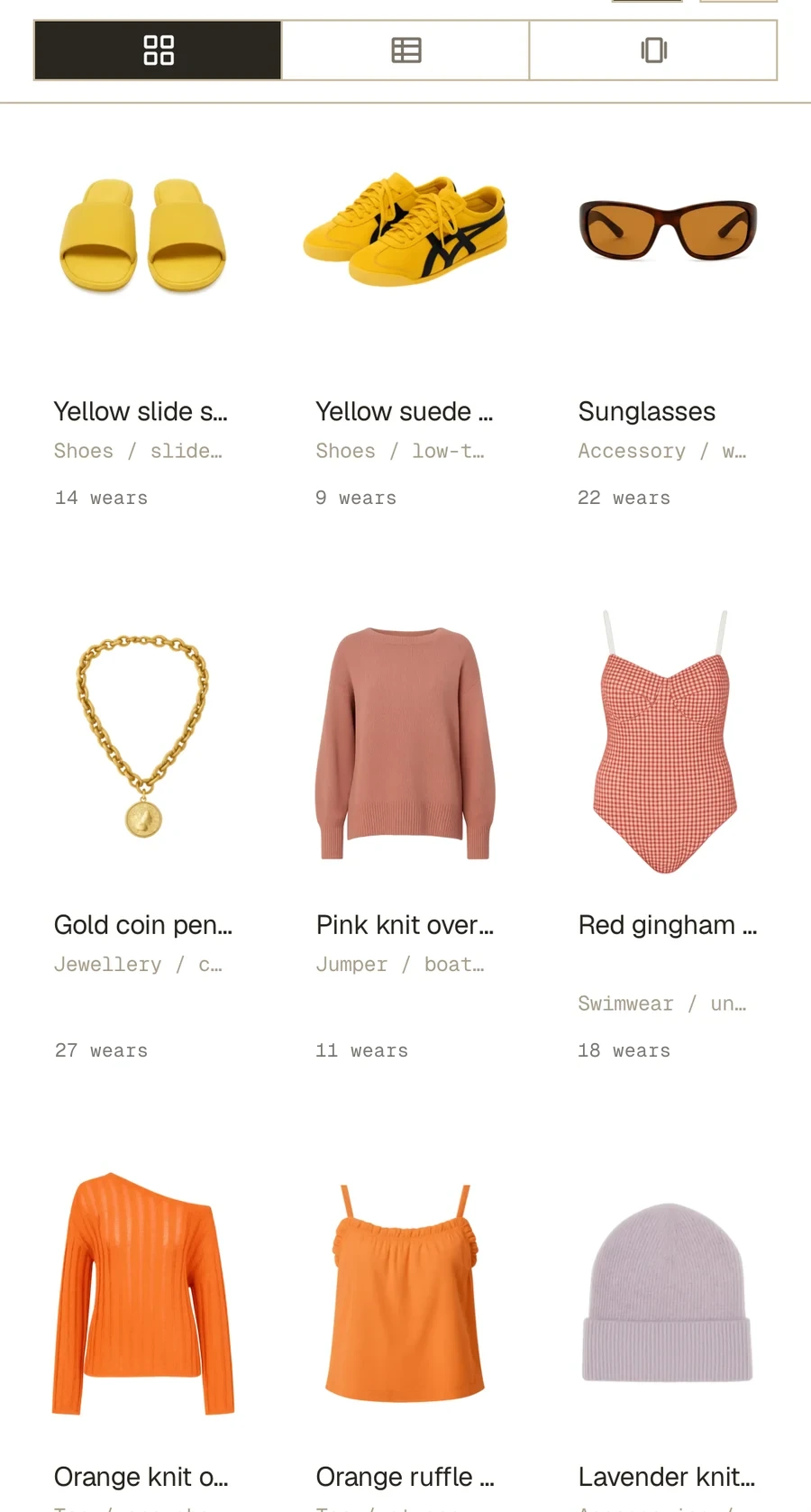
With a Modebase wardrobe, getting your clothes in is not a typing job. Photograph a pile on the bed or a full rail and it separates out the individual pieces and writes the detail itself. Or build it as you go: take a fit check on your way out the door and what you are wearing goes in. There is no column order to learn and no file to keep current.
Then nothing is ever uploaded, because nothing needs to be. Ask about your navy skirts and it goes and looks, whether you own forty pieces or four hundred. The answer comes back as pictures of your actual clothes rather than a paragraph describing them. And the things you learn have somewhere to go: say the bag is too small once and it is saved onto that bag, so it surfaces every time that bag is considered, this Saturday and in two years.
It is free to try, with no card and no time limit. the full ChatGPT wardrobe guide.
If you are not there yet, the spreadsheet route above genuinely works. Start with the twenty things you wear every week rather than the back of the cupboard, and put the date in the filename so you can see at a glance how far out of date it has drifted.
Frequently asked questions
Can I upload my clothes to ChatGPT?
Yes. A spreadsheet of your wardrobe works best, especially kept in a Project so it persists between chats. Photographs work for a garment or two, but a whole photographed wardrobe runs into per-file limits, and the chat ends up working from its description of the photo rather than the photo itself.
What format should I upload my wardrobe in?
CSV or XLSX, with one row per garment and each piece described in a full phrase rather than two words: what it is, the colour, the fabric, how dressy it is and when you would wear it. Vague rows are the single most common reason a piece never comes up.
How many clothes can I upload to ChatGPT?
More than you would expect as text, far fewer as photographs. A 150-row spreadsheet is comfortable. A hundred and fifty photographs is not. For any one question, a filtered subset of twenty-five to forty rows pasted as text beats the whole file.
Does ChatGPT keep my uploaded wardrobe?
A file in a Project stays available to chats in that project, so in that sense yes. What it will not do is keep it accurate. Nothing tells the file you bought a coat, and nothing warns you that the answer you just got was built from a cupboard you no longer have.
Is there a way to avoid uploading it at all?
Yes, and it is the point of a connected wardrobe. With Modebase connected, your clothes are looked up when you ask rather than uploaded in advance, so nothing goes stale and nothing needs re-sending.