How to use ChatGPT as a personal stylist with your own clothes
Let us be honest about the thing in the title first, because it will save you a fortnight.
ChatGPT is not a stylist and it will not replace one. A stylist looks at you, works out the shape of your life, and tells you the truth about the dress. None of that can be conjured out of a chat window. What ChatGPT is genuinely very good at is taking knowledge it has been handed and applying it, patiently, at ten to eight in the morning, when no human stylist is standing in your bedroom.
So the job is not finding a magic prompt. The job is handing it the right things. Do that and it is properly useful. Skip it and you get a camel trench you do not own.
The short version
Three things make the difference: your actual clothes, your actual constraints, and a rule that stops it inventing. Give it those and the advice stops being generic within one message. Everything below is how to hand each one over, and how to stop doing it by hand every time.
Why the advice is always about someone else
Ask what to wear and you will get a tailored blazer, a crisp white shirt, straight-leg jeans and a camel coat. It is not wrong. It is the average of everybody, and the average of everybody has a camel coat.
This is not the model being stupid. It has never seen your cupboard, so it is answering the only question it can answer, which is what a person in your situation might wear. You wanted the other question: what should I wear, out of what is hanging two feet away.
Everything that goes wrong flows from that one gap. It suggests things you do not own. It repeats what you wore on Tuesday, because nothing told it about Tuesday. It hands back a pairing you already rejected. And it cannot show you a single thing, so you are left translating a paragraph into garments.
What to hand it, in order of how much it changes the answer
1. The clothes
Nothing else comes close. Twenty-five to forty pieces you would genuinely consider today beats a list of everything you own, because a short list stays in view and a long one quietly stops being read.
Describe each piece properly. Silk shirt, ivory, dressy, works for the office and for dinner gets found later. Ivory shirt mostly does not. The layout in the wardrobe inventory template exists for exactly this, and the four ways to tell ChatGPT what is in your closet compares the methods honestly.
2. The person
Tell it, once, the things a friend would already know. What you never wear. How high a heel you will tolerate. That your office is freezing in summer. Your size and roughly your proportions. The words you do not want used at you, if "elevated" and "effortless" make you want to lie down.
This is the part ChatGPT holds on to well between conversations, and it is worth doing properly, because it stops the guessing at the person and leaves only the guessing at the clothes.
3. The rule that stops it inventing
One line, and it changes everything:
Only use items from the list I gave you. If it is not on the list it
does not exist. If an outfit needs something I have not listed, tell me
which slot is empty and stop, rather than filling it in.
Without this it will finish an outfit with a simple white sneaker you have never owned, with total confidence. With it, a gap becomes information instead of fiction.
4. The occasion, properly
"Work" is weak. "Office, but a client meeting at two and drinks after" is strong, because it tells it the outfit has to survive three different rooms. Weather in degrees, not seasons. And say what you wore recently, because otherwise you will be handed Tuesday again.
A prompt that puts it together
Here is what is available to me today:
[your list]

About me: I never wear anything cropped, no heels above 4cm, my office
is cold, I am 172cm and a size 12 AU.

Today: office, client meeting at 2, drinks after. 14 to 19 degrees,
windy. I wore the black trousers yesterday.

Build me one outfit from the list above. Only use items on the list.
Tell me in one line why it works, and name anything the list is missing
rather than inventing it.
That will get you a good answer. It will also get you typing the same block tomorrow, and the day after, which is where most people quietly stop.
Where this stops being worth doing by hand
Everything above works. The problem is that it is all maintenance. Your list goes out of date the moment you buy a coat or take a hem up. It has no record of what you actually wore, so the repeats keep coming. And it is still only words, when the thing you are choosing between is visual.
The alternative is to stop handing it your wardrobe every morning and keep the wardrobe somewhere it can reach.
What a Modebase wardrobe hands over instead
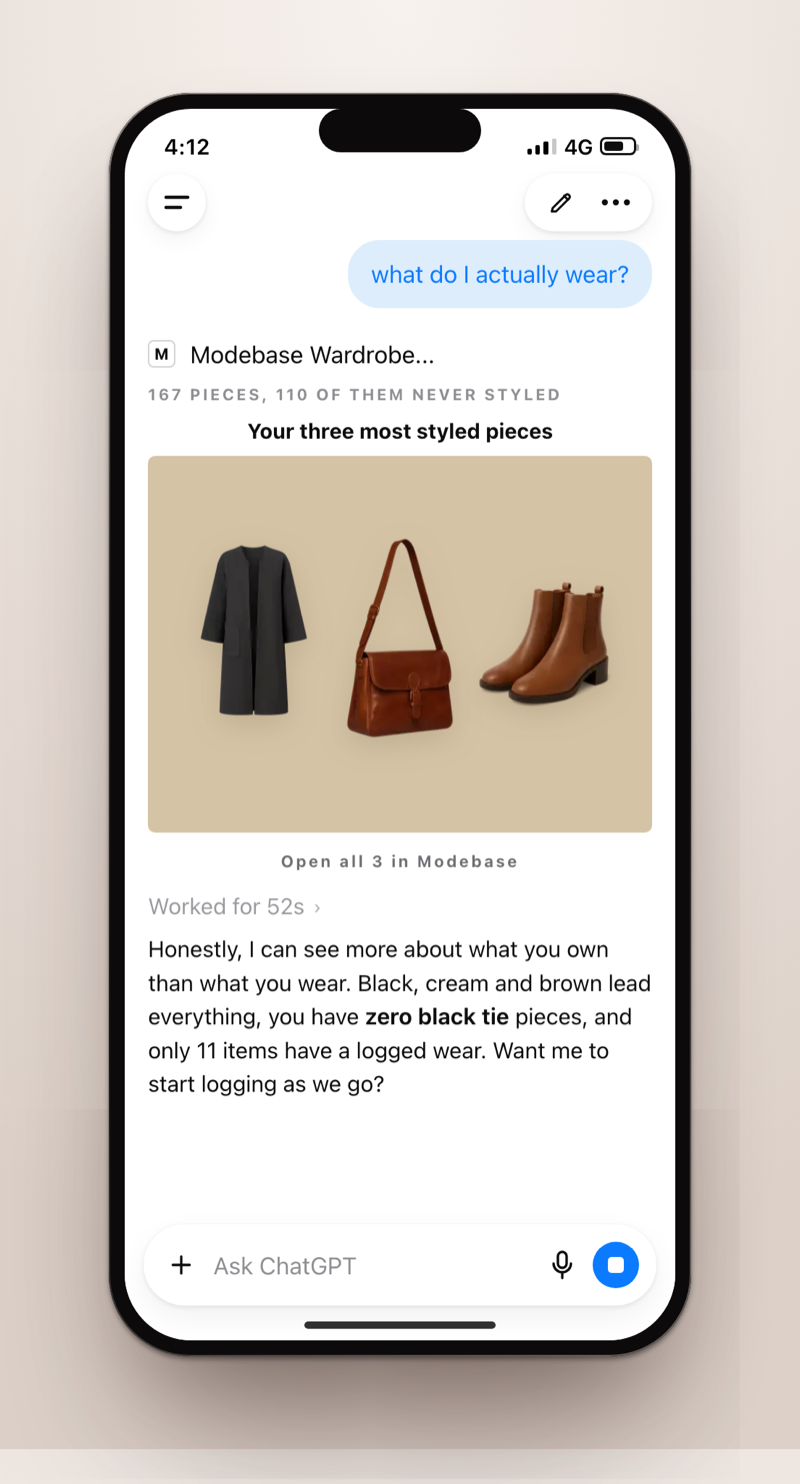
Modebase is not a stylist either, and it is more than an app. It is the wardrobe underneath the chat you already use, and it hands over the three things above the moment you ask, without you typing any of them.
Your real pieces, with their detail. Not "black trousers" but the actual trousers, their fabric, their cut, the length that only works with a heel, the colour that is nearly black. Ask about your navy skirts and you get your navy skirts, whether you own forty pieces or four hundred, because they are looked up rather than remembered.
Your style profile, built as you go. The rules you would otherwise retype every morning live on your profile, and they grow every time you correct something. Say the neckline does not suit you once.
And what you say sticks to the garment. Too long without a heel. Only ever with flats. I felt wonderful in this. That goes onto the piece, so it comes back every time that piece is considered, next Tuesday and in two years.
Then the answer arrives as pictures of your own clothes rather than a paragraph, which is the part people do not expect and the part that ends the scepticism.
It is free to try, with no card and no time limit. how to use your real clothes with ChatGPT.
Frequently asked questions
Can ChatGPT be my personal stylist?
Not in the way a person can. It cannot see you, and it cannot invent the structure a stylist brings. What it does very well is apply what it is given, consistently and at any hour. Hand it your real clothes and your real constraints and it becomes genuinely useful. Hand it nothing and it describes a wardrobe that belongs to somebody else.
What should I tell ChatGPT to get better style advice?
In order: the clothes available to you today, the things about you that never change, a rule forbidding it from using anything you have not listed, and the real shape of the day including weather in degrees and what you wore yesterday.
Why does ChatGPT suggest clothes I do not own?
Because nothing has told it what you own, and it will fill a gap rather than admit to one. A single line forbidding invention fixes most of it. A wardrobe it can actually read fixes all of it.
Is there a prompt that makes ChatGPT a stylist?
There are prompts that supply the structure it cannot come up with alone, which is the honest version of the same thing. The free stylist prompt reads a photo of you and builds a personal style guide, and the fit check prompt gives an honest read on the outfit you have on. Neither needs an account.
Do I have to retype my wardrobe every time?
By hand, more or less yes, because a list pasted into one conversation belongs to that conversation. A Modebase wardrobe is read from wherever you are asking, so the list is never typed and never pasted.