Start cycle-syncing your wardrobe
It is 6am and I am woken up feeling bloated and with an ache in my back. Yesterday, when I had fantasised about leaving my husband and setting myself up in a little cute apartment with nice plants in each corner, a couple of cats and some pleasing crockery, simply because he had left his shoes in the hallway again, I had a sneaking suspicion it could be that time of the month. I do not want to uproot my entire life, but right now I feel bloated, achey and I want to be left alone.
But the day must go on, so I roll out of bed to get dressed.
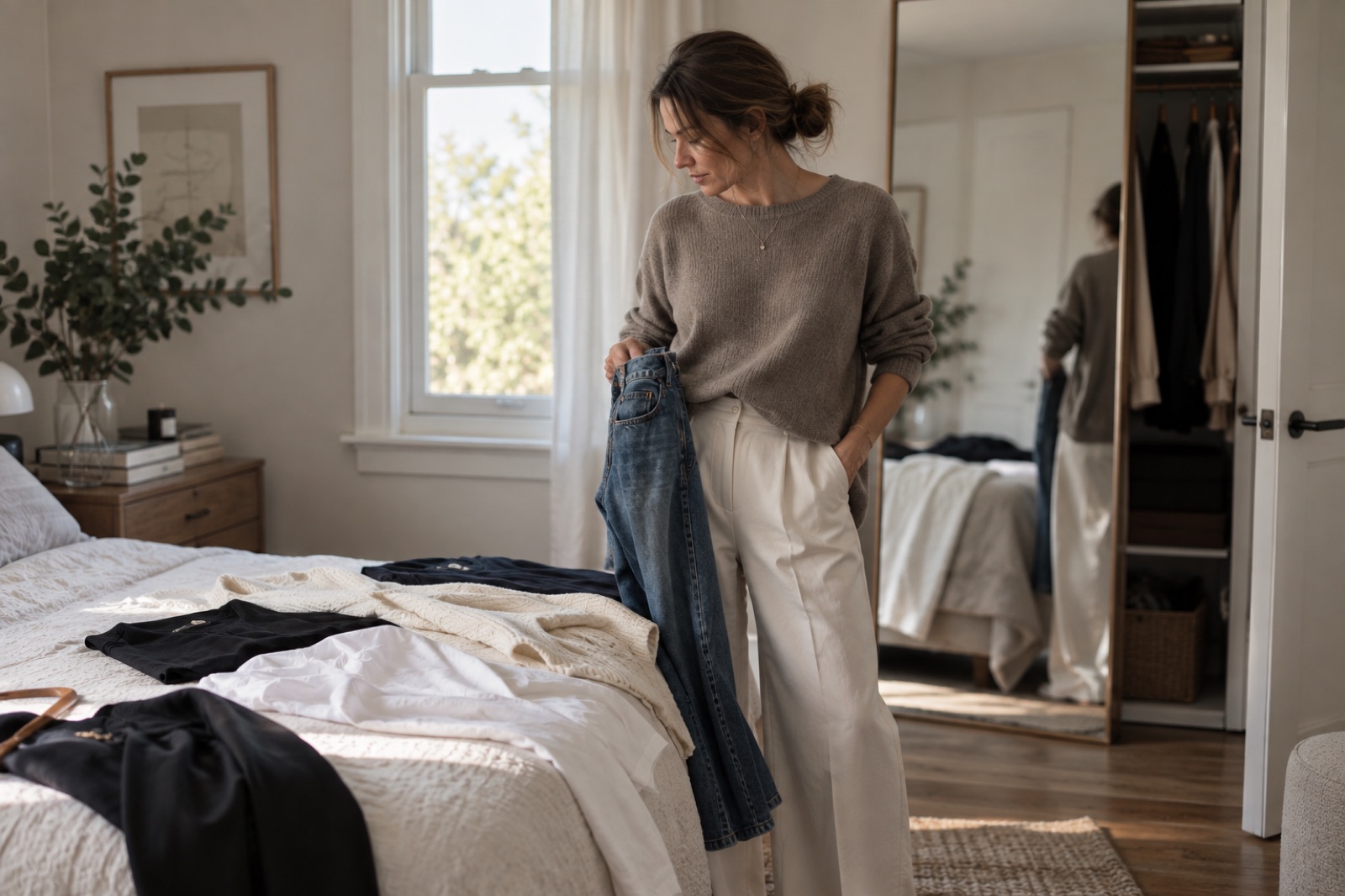
The jeans went on first. The same jeans I wore a couple of weeks ago, when I felt tall and sharp and caught my reflection in a shop window and thought, oh, hello. Today they dig in at the waist and sit wrong on my hips. Off they come. The fitted knit is next, and it clings to a stomach that feels three sizes bigger than it did at the weekend. Then a shirt that suddenly feels scratchy at the collar. Then, finally, the soft wide-leg trousers I nearly gave away last year, a loose tee, and an oversized cardigan. I am late, I am a little teary, and I have somehow convinced myself this is a character flaw.
It is not. It is day 1.
Cycle-syncing your wardrobe means dressing with your menstrual cycle rather than against it, matching what you wear to the phase you are in, menstrual, follicular, ovulatory or luteal, using the clothes you already own. In each phase your body, your energy and even how fabric feels against your skin can shift, so the pieces that feel right shift too. Here is how it started to change my mornings, and how it now works.
The same wardrobe, a different phase
For years I thought I had a wardrobe problem. I would buy something, love it, wear it three times, and then one morning it would feel completely wrong on me. I blamed the fabric, the cut, my body, my lack of willpower around biscuits. I never once thought to look at the calendar.
Then I started noticing a pattern. There is a week every month when everything works. I pull on a slip skirt and heels just because. I wear the bright lipstick. I put on the statement earrings on a random Thursday and I feel like the most magnetic person in the room. And there is a week, reliably, when my body asks me for softness and I spend the whole morning refusing to listen.
My clothes were never the problem. My timing was.
Closet syncing is quietly becoming a thing
I am not the only one. Writing for Fashion Journal, Stephanie Simons describes being asked on a panel when she feels most comfortable in her clothes, and answering without a second thought that it depends where she is in her cycle. The room went quiet, and then curious. She had never framed it as a deliberate choice until she said it out loud, and I felt that in my bones.
We already talk about syncing our workouts, our food, even our work calendars to our hormones. Fashion is still catching up. But our bodies shift from week to week. We bloat, we ache, our energy rises and crashes, and even how fabric feels against our skin can change. Why would what we wear stay the same?
Stylist Katie Allen, speaking on Renae Fieck's podcast, put it in a way I keep coming back to: our confidence is built in those micro-moments. Getting dressed is one of the first of those moments every single day. When the outfit fights you, the whole morning starts on the back foot.
How the four phases feel in my wardrobe
Everyone is different, and this is not a rulebook. But here is roughly how it goes for me, and for a lot of the women I have talked to.
Menstrual phase: soft and held
This is my winter. I want to be held by my clothes, not squeezed by them. Soft knitwear, relaxed trousers, a big linen shirt, layers I can take off when I get hot and pull back on when I get cold. Naturopath Amber Carter makes a lovely point here: natural fibres like cotton, merino and linen breathe and regulate temperature, which matters a lot when your body already feels like it is doing too much.
Follicular phase: light and playful
The reset. My body feels lighter and I suddenly want to play. This is when I try the combination I talked myself out of last week, pull the forgotten piece from the back of the wardrobe, and experiment with colour. If I am going to take a style risk, it happens now.
Ovulatory phase: bold and confident
My summer. High-rise jeans, sharp tailoring, something a little sheer, the jewellery I usually save for occasions. I feel confident and social and I want my clothes to say so. Amber Carter suggests we stop saving our favourite pieces for special occasions and wear them when our energy naturally supports it, and honestly, that advice changed how I shop.
Luteal phase: easy and forgiving
The slow-down. Bloating, tenderness, a shorter fuse, a stronger need for ease. This is the phase that used to produce the pile of rejected outfits on my bed. Now it is the phase of elastic waists that still look polished, flowy dresses that do not cling, and blazers with soft shoulders. Stephanie Simons describes these pieces as feeling like permission, and that is exactly it. They let me show up fully without pretending my body is not doing what it is doing.
Nutritional therapist Tammy Gee frames the cycle as four seasons, with the days before a period being the moment we start to close the cave door and get cosy. She also gave her nagging inner critic a name so she could tell it to be quiet when she chose yoga pants on day 29. I love that. The goal is not to fight yourself into the right outfit. It is to stop fighting at all.
So we built it into Modebase
Modebase has always been about knowing you well enough to dress you right. Your pieces, your fit, your weather, your life. Cycle phase felt like the missing layer, because it is one of the most personal signals there is and it changes how you feel in the exact same clothes.
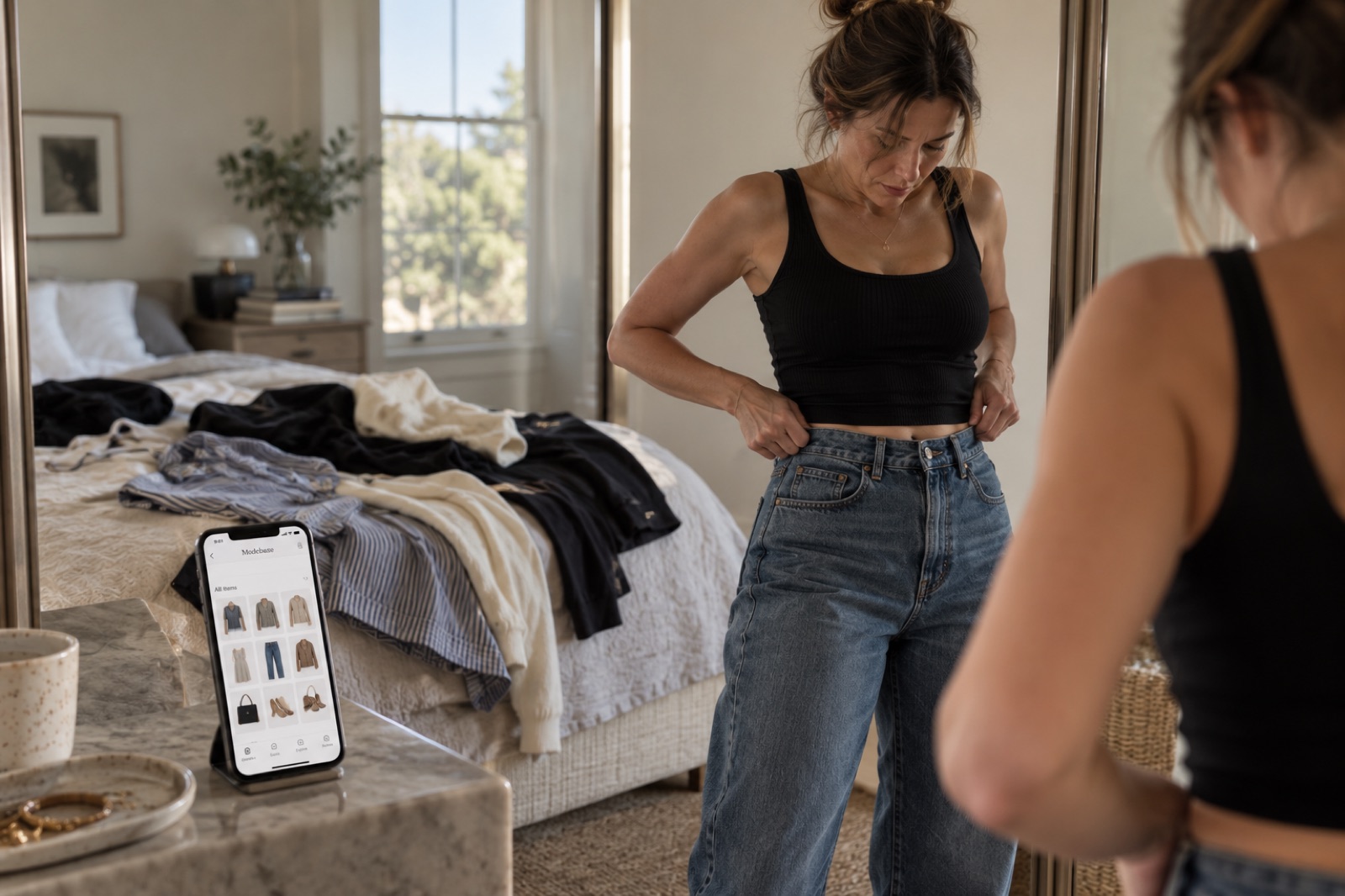
There are two ways it works.
Modebase learns your patterns. This part is coming, and it will always be something you switch on, never something that happens to you. Modebase already keeps a record of what you actually wear. Turn on cycle learning and, over time, it notices the rhythm in that record, which pieces come out when, and gathers your phase wardrobes for you without you tagging a thing. Picture Sarah, who never sorted her closet by cycle. Her luteal weeks lean on eight familiar pieces: the wide-leg trousers with the elastic waist, the oversized oatmeal cardigan, a washed grey tee, the black midi that skims rather than clings, a slouchy ribbed knit, flat leather loafers, an open linen shirt and a soft-shouldered blazer. Her ovulatory weeks look like a different woman got dressed: high-rise straight jeans, a fitted rib top, the sharp blazer, a slip skirt and the gold earrings she used to save for occasions.
Or you tag your pieces yourself. This one is here today. When you look at any piece in your wardrobe, you can tag it with the phase or phases it belongs to: menstrual, follicular, ovulatory, luteal. Pick as many as feel right. That oversized blazer might live in both luteal and menstrual. The sculpting jeans might be ovulatory only. Your favourite tee might belong to all four, and that is completely fine.
Then, on the mornings you need it, you open your wardrobe and filter by phase. Show me my luteal clothes. Suddenly the decision is already half made, by the version of you who was feeling clear-headed and kind to herself when she did the tagging.
It is not about owning four separate wardrobes. It is about recognising the pieces you already reach for in different moments and making them easy to find when your patience is lowest.
Your cycle is yours
A few things we were very deliberate about.
We never track your cycle unless you ask us to. Tagging your clothes needs nothing but your own notes, no dates, no period logging, no health data, the same way you might note that a dress runs small or a jumper needs hand washing. Cycle learning is the only part that ever looks at more, and it stays switched off until you turn it on yourself.
It is completely optional. If cycle syncing is not for you, you will never have to see it.
And it works however your body works. Not everyone has a textbook 28-day cycle. Maybe yours is longer or irregular, maybe you are on hormonal contraception, maybe you are in perimenopause and everything is shifting. As Tammy Gee puts it, whatever is usual for you is normal. Because the tags are about how you feel in your clothes rather than a date on a calendar, you can use them in whatever way matches your own rhythm.
Meeting yourself where you are
The best outfit is not the one that looks good in theory. It is the one that works with the body you woke up in today.
On good days, I want my wardrobe to match my energy. On hard days, I want it to take care of me. Cycle syncing in Modebase is our way of giving you both, so the next time you are standing in front of the mirror on day 1, you can skip the pile on the bed, reach straight for the soft trousers, and head out the door feeling like yourself.
Sources and further reading
- Stephanie Simons, Why I have started cycle-syncing my wardrobe, Fashion Journal.
- Renae Fieck with Katie Allen, How To Dress According to Your Menstrual Phases.
- Amber Carter, Dress for Your Body, Your Season of Life and Your Hormones, Infinite Health Studio.
- Tammy Gee, Dressing with your menstrual cycle in mind, Seven Colours of Nutrition.