How to put outfits together when you have no idea where to start
The short answer: start with one anchor piece, add a base that goes with it, finish with shoes and one extra layer, and keep the whole outfit to about three colours. That is nearly every good outfit. The rest of this guide shows how, with formulas you can use this morning.
If the problem is that you feel you have nothing to wear at all, start with what to wear when you have nothing to wear. If you already know what you like and need a rule or two to get it together, you are in the right place.
Rule 1: start with one anchor piece
Do not stand in front of the wardrobe and try to see the whole outfit. Choose one piece you want to wear today, and build around it. It might be a pair of trousers you love, a jumper that is still clean, or a dress you have not worn for months. One decision instead of ten.
Rule 2: keep to three colours
Count the colours in your outfit. Aim for three at most, and count neutrals (black, white, navy, grey, beige, denim) as quiet colours. A simple pattern is two neutrals plus one colour you like. If you want to wear two bold colours, make everything else neutral.
Rule 3: balance loose and fitted
If one half of the outfit is loose or oversized, keep the other half closer to the body. Wide trousers with a fitted top. A big jumper with slim jeans or a straight skirt. When both halves are loose, outfits tend to look shapeless, and when both are very tight, they feel stiff. You only need a contrast.
Rule 4: one statement at a time
Pick one piece to be the star: a bright colour, a bold print, a strong texture or a dramatic shape. Let everything else stay quiet. Two competing statements, like a loud print with sequins, tend to cancel each other out.
Rule 5: finish it
Most outfits that feel unfinished are missing the last 10 percent. Add one of these:
- Shoes that suit the mood. The same trousers look casual with sneakers and polished with loafers.
- A layer. A blazer, cardigan or jacket makes a plain top look put together.
- One accessory. A belt, a scarf, earrings or a bag.
Six outfit formulas to use this morning
| Formula | Example |
|---|---|
| Fitted top, wide trousers, loafers | White tee, black wide leg trousers, tan loafers |
| Oversized top, slim bottom, sneakers | Big knit, dark jeans, white sneakers |
| Dress, jacket, ankle boots | Midi dress, denim or leather jacket, boots |
| Shirt, knit vest, straight trousers | Striped shirt, grey vest, navy trousers |
| Matching colour top to bottom, one contrast | Cream knit and cream trousers, a tan belt and bag |
| Skirt, tucked tee, blazer | Midi skirt, plain tee, a tailored blazer, flats |
Swap in your own pieces. The formula matters more than the exact items.
One piece, five ways
The fastest way to learn outfit building is to take one piece and wear it differently. Take a white shirt:
- Buttoned and tucked into tailored trousers, with loafers, for work.
- Open over a tee with jeans and sneakers, for the weekend.
- Over a swimsuit or tank with shorts, as a beach cover-up.
- Tied at the waist over a slip dress, as a layer for the evening.
- Worn back to front as a jacket over a dress, with the sleeves pushed up.
Try the same with a pair of jeans, a blazer or a favourite skirt. You will find that each piece works in at least five outfits, and you start to see your wardrobe as combinations instead of single items.
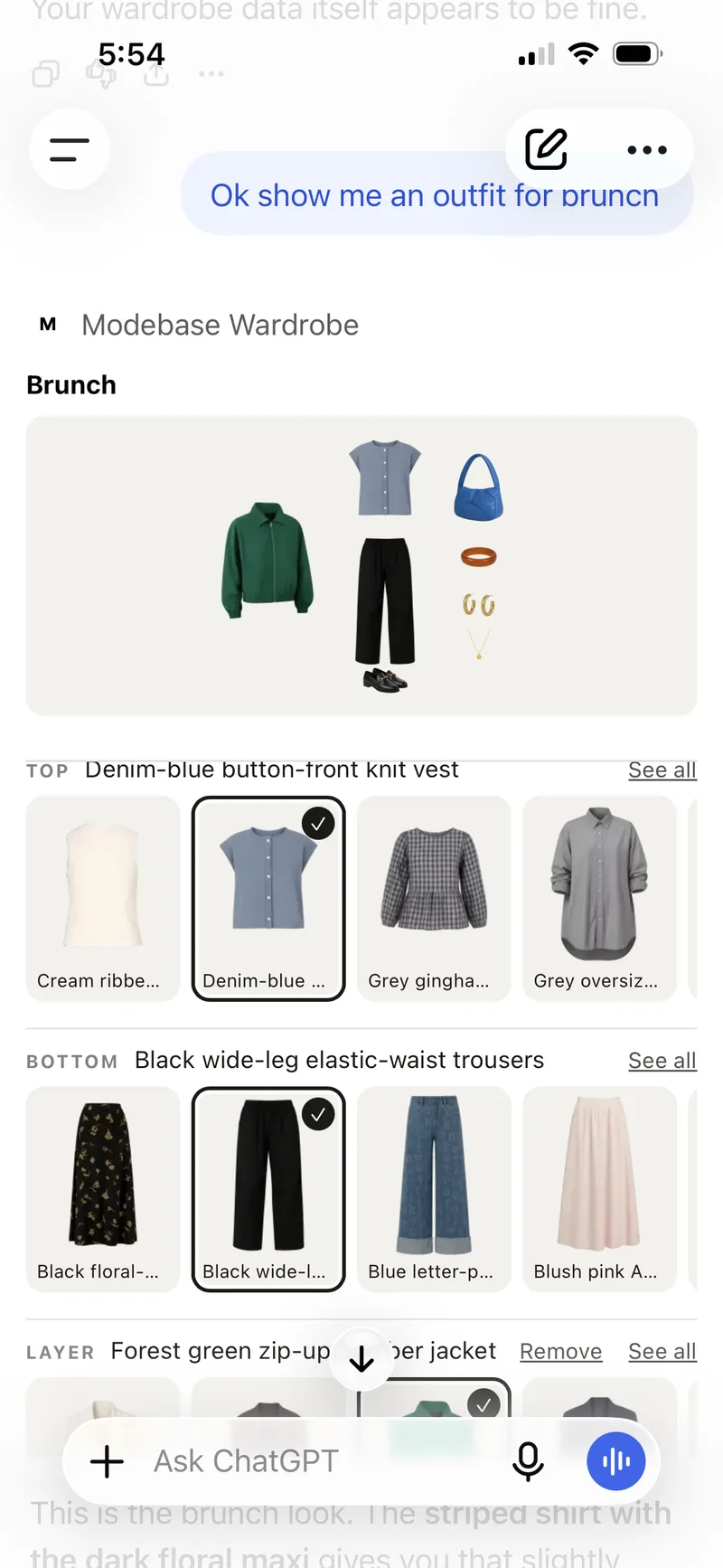
When your pieces are in Modebase, this is what you see: a look you can change one piece at a time.
Three questions to check any outfit
- Could I wear this all day? If you will fidget, change it.
- Is there one star? If everything is competing, quiet one piece down.
- Does it look finished? If not, add shoes, a layer or one accessory.
If you are stuck on a particular piece
Start with the piece, not the outfit. Lay it on the bed. Then add the item that is most obviously its partner, such as the usual top with the usual trousers. Now change one thing: the shoes, the layer or the top. Photograph each version. In two or three tries you will find the one you like. For a work wardrobe, see smart casual explained. For a trip, see how to pack for a week away with 12 pieces. If you want an assistant to do the building, see how to use ChatGPT as your personal stylist.
Start with what you already own
Most of the outfits in this guide are already hiding in your wardrobe. The hard part is seeing your clothes together. Photograph one outfit you already wear and Modebase picks out each piece for you. Then you can ask for outfits in the chat you already use, such as ChatGPT or Claude, and it answers from your own clothes. For example:
I want to wear my green cardigan today. Show me four different outfits from my wardrobe built around it, and tell me which one suits a day at the office.
Frequently asked questions
How do I start putting an outfit together?
Choose one anchor piece you want to wear, then add a base that goes with it, finish with shoes and one extra layer, and keep the outfit to about three colours.
How many colours should be in an outfit?
Aim for three at most, counting neutrals like black, white, navy, grey, beige and denim as quiet colours. Two neutrals plus one colour you like is a simple pattern.
Why does my outfit look unfinished?
Usually it is missing shoes that suit the mood, a layer such as a blazer or cardigan, or one accessory. Add one of these and check again.
How can I make more outfits from the clothes I own?
Take one piece and wear it five different ways, changing the bottom, the shoes and the layer. Photograph each version, and you will see your wardrobe as combinations instead of single items.