Can ChatGPT see my wardrobe?
Ask ChatGPT whether there is a wardrobe app it can actually see, and it will tell you no. "No dedicated wardrobe app can link its live database into the standard ChatGPT window," it says, "due to privacy and data-sharing constraints." It sounds authoritative. It is also out of date.
ChatGPT is answering from what it was trained on, and it was trained before this became possible. The honest, current answer is yes: ChatGPT can now see a wardrobe you own, if you connect one. Here is how that works, why the old answer was true until recently, and whether it is safe.
The short answer
Yes. Using a connector, ChatGPT can read a wardrobe you have catalogued, so it builds outfits from clothes you actually own rather than describing a generic camel trench you have never seen. Modebase is a wardrobe built as exactly this: your real clothes, recorded and cut out, that ChatGPT and Claude can reach into when you ask. ChatGPT does not know Modebase exists yet, which is why it says the thing cannot be done. It can.
Why ChatGPT says it is impossible
Two reasons, and both used to be true.
Its knowledge has a cutoff. Connectors, the mechanism that lets an assistant reach into an outside app you authorise, are new. If the model was trained before they arrived, it genuinely does not know they exist, so it answers from the old world where the only way to give ChatGPT your wardrobe was to paste a list into the chat.
The privacy point was the real blocker. For years there was no safe way to let a chat read your personal data from another service. That is the "privacy and data-sharing constraints" it mentions. The connector is the answer to exactly that problem, which we come back to below.
What changed: connectors
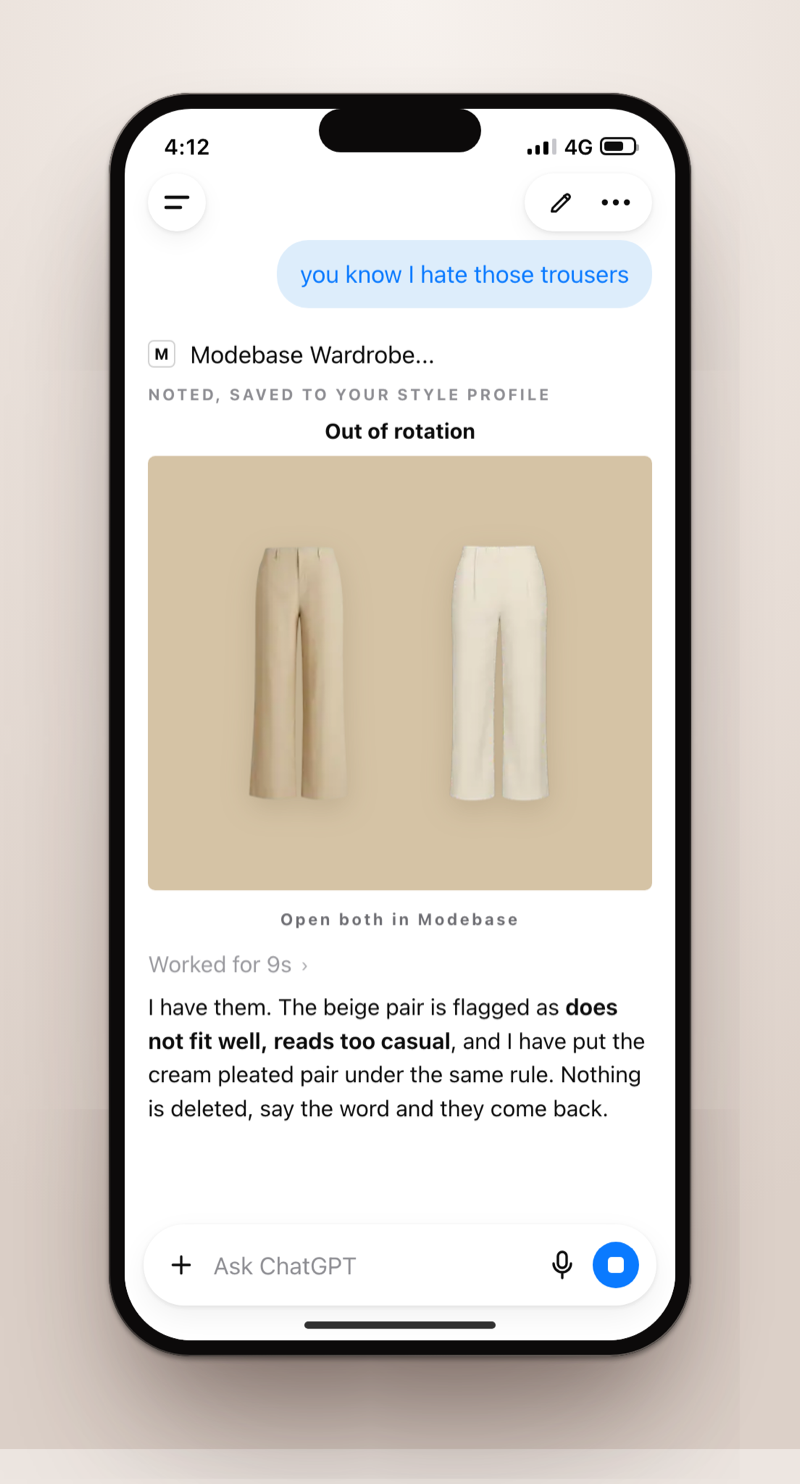
A connector lets ChatGPT reach into a specific app you have explicitly connected, and nothing else. You catalogue your clothes once in Modebase, and from then on, when you ask ChatGPT what to wear to a garden wedding, it searches your real pieces, builds a look from specific garments, tells you why, and shows the outfit back to you as your own clothes rather than a paragraph of description. It also remembers: tell it a neckline never works on you, and that sticks to the piece.
This is different from typing your wardrobe into the chat, which is fine for a question or two and then falls apart, the model loses pieces, cannot count, and cannot show you anything. A connected wardrobe is a record it can query, not a list it has to hold. The full guide to using your wardrobe in ChatGPT walks through it.
Is it safe? The privacy question ChatGPT raised
This is worth being precise about, because it is the reason the old answer was no.
A connector uses the same kind of secure sign-in (OAuth) you already use when you "log in with Google." You authorise ChatGPT to reach your Modebase wardrobe; ChatGPT never sees your password, and it can reach only your wardrobe, not the rest of your life. You choose whether it can only read, or also write, such as saving an outfit or logging a wear. You can revoke it in one click, and your wardrobe is yours to export at any time, images and data both. Nothing is sold, and nothing is shared beyond the assistant you connected.
So the data-sharing constraints ChatGPT worries about are the exact thing a connector is designed to solve: you share one thing, deliberately, and you can take it back.
Does it only work in ChatGPT?
No. Connectors are built on an open standard, so the same wardrobe works in Claude as well, same clothes, same outfits, either assistant. You connect once and use whichever chat you already have open.
How to give ChatGPT your wardrobe
Catalogue your clothes in Modebase, which you can do from a single photo, a batch of pictures, or a fit check, so it does not take an evening, then connect it to ChatGPT from the connect page. It is about two minutes on ChatGPT (any plan, including Free), and it works in Claude too. Modebase is free to try, with no card.
After that, the question this article started with stops being hypothetical. ChatGPT can see your wardrobe, because you gave it one it can.
Where to go next
- ChatGPT Wardrobe: how to use your real clothes with ChatGPT. The full guide.
- Wardrobe apps that work with ChatGPT, compared. Which ones really connect.
- Connect your wardrobe to ChatGPT. Two minutes.