The best AI wardrobe apps in 2026 (and the question nobody asks)
My friend Cath has three wardrobe apps on her phone. Between them she has photographed, cropped and tagged something like four hundred garments, which is six evenings of her life she is not getting back. Last month I asked her what she had worn to a work thing the week before.
"The black ones," she said.
Three apps. Four hundred garments. Cost per wear, colour analytics, a capsule builder, a styling chatbot with a friendly little bubble. And the answer is the black ones.
This is the bit the reviews skip. The AI in these apps is genuinely good now, better than most people expect. The thing that fails is not the intelligence. It is that the intelligence lives inside an app you have to remember to open, at the exact moment of the morning when you are least likely to open anything.
Disclosure: Modebase publishes this article and Modebase is one of the apps in it. Where another app is better at something, we have said so, and there are several places where they are. Pricing was checked in September 2026 against official sites and app store listings, and it changes, so look before you pay.
The question to ask before you download anything
Not "does it have AI". They all have AI. In 2026 that sentence carries about as much information as "it has a search bar".
The question is where the intelligence lives, and there are only two answers.
AI inside the app. The app calls a model behind the scenes and shows you outfit suggestions in its own interface. This is most of the category. It is a real feature and some of them do it beautifully. What it means in practice is that the styling only happens in the place you have to go to, and going there is a decision you have to make before you have had coffee.
A wardrobe your assistant can reach. The clothes live in a database that ChatGPT or Claude can query directly. You do not open a wardrobe app. You ask, in the chat you already have open, and the answer comes back built from the actual contents of your cupboard.
Both are legitimate. They suit different people. But almost every "best AI wardrobe app" list on the internet mixes them together as though they are the same product, and they are not, and the difference is the entire reason Cath's four hundred garments are not helping her.
At a glance
| App | Where the AI lives | Best for | Price |
|---|---|---|---|
| Modebase | In ChatGPT and Claude, reading your real wardrobe | Styling the clothes you own without opening an app | Freemium for capsule wardrobes |
| Acloset | Inside the app | Automatic cataloguing and daily suggestions | Free to 100 items, from £3.99/mo |
| Cladwell | Inside the app | Capsules, and the fastest setup in the category | From $4.99/mo |
| Whering | Inside the app | A free, analytics-heavy closet | Free |
| Indyx | Human stylists, not AI | Paying someone else to do the hard parts | Free core, $12.99/mo |
| Vesta | Inside the app, deliberately | Automated intake from receipts and camera roll | Free, Pro price unpublished |
| Getwardrobe | Inside the app | Using the same closet on every device you own | Free to 100 items, $9.99/mo |
| Stylebook | No AI to speak of | Data, control, and no subscription ever | $4.99 once, iOS only |
1. Modebase
Best for: people who already ask ChatGPT what to wear and are tired of describing their clothes every single time.
Modebase is not a styling app with AI bolted on. It hands the assistant you already talk to your actual clothes and your actual taste, so what comes back is styled for you specifically. You connect it once, and after that ChatGPT can search your pieces, build an outfit from specific garments you own, show you the look, log what you wore, and remember that you do not wear that neckline, ever, no matter how many times it is suggested.
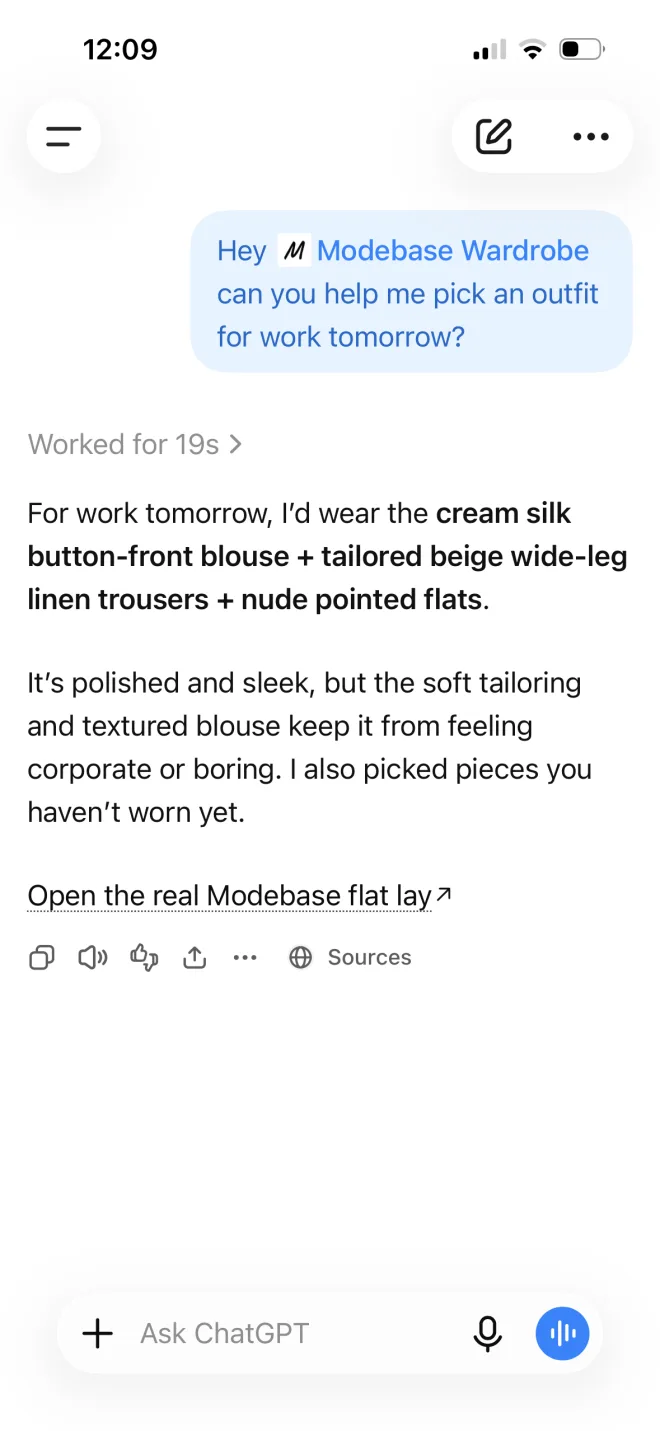
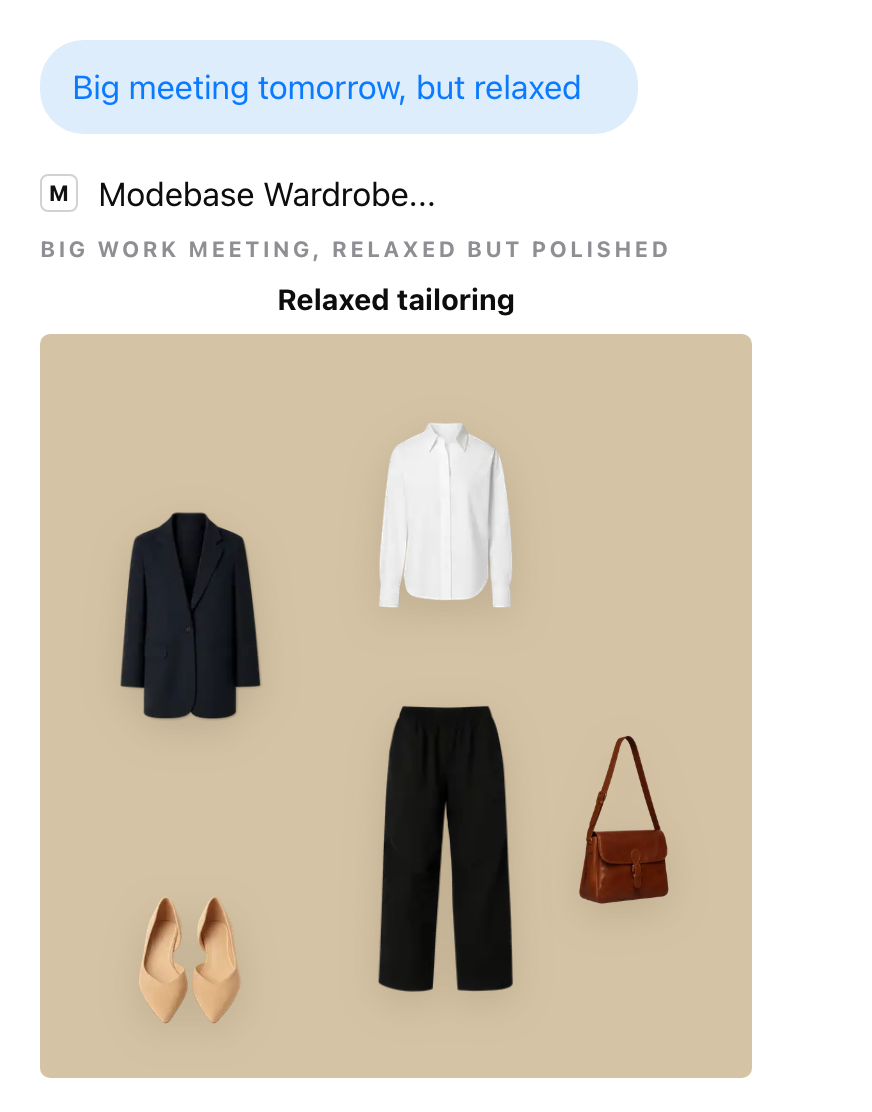
The part that gets the least attention and matters the most is that it writes back. Logging a wear is one sentence in a conversation you were having anyway, which means the wear data actually accumulates instead of dying in week three like every manual tracking system ever built. After a couple of months you have something genuinely rare: a true record of what you wear, as opposed to what you believe you wear.
Where it is weaker: if what you want is a beautiful app to scroll on the sofa, this is not it. There is no social feed, no human stylist, no resale marketplace. It is a layer under your chat, and if you do not use an AI chat, it is not for you.
Price: free to try with no card and no time limit. For more room, Wardrobe at US$9.99 a month (US$99 a year) holds up to 500 pieces, and Collection at US$18 a month (US$176 a year) holds up to 2,000 with the deeper wardrobe intelligence. Cancel anytime.
2. Acloset
Best for: getting the cataloguing over with as painlessly as possible.
The largest of these by user base, with genuinely capable AI recognition that sorts and tags as you add, a chatbot stylist, virtual try-on, personal colour analysis and weather-aware daily suggestions. Free to 100 items, then tiers from about £3.99 a month.
Where it is weaker: reviewers consistently note there is no bulk upload, so it is one garment at a time, and the tags occasionally need correcting. All of the cleverness stays inside Acloset.
3. Cladwell
Best for: anyone who has abandoned a wardrobe app at the photography stage. Which is most people.
Cladwell's answer to cataloguing is the best in the category: instead of photographing everything, you tap your items from a catalogue of roughly fifteen thousand garments, so an evening's work becomes twenty minutes. Its capsule methodology is the most thought through of any app here, and its daily weather-aware suggestions are good. Its site says "Powered with ChatGPT", which is honest phrasing for OpenAI's model running inside Cladwell. You cannot open ChatGPT and ask it about your Cladwell closet.
Where it is weaker: tapping a lookalike from a catalogue is not the same as your actual jumper, with its actual colour, and for some people that gap never stops being annoying.
4. Whering
Best for: a free closet that tells you the truth about your habits.
The most generous free full-featured closet available, with automatic background removal, a Chrome extension, and the best consumption analytics in the category: cost per wear, wear rate, seasonal reports. If you want a well-built digital wardrobe on your phone and you do not want to pay, Whering is the one to beat.
Where it is weaker: the social layer is not for everyone, some features sit behind credits, and there is no way to reach any of it from an AI chat.
5. Indyx
Best for: paying to skip the boring part and talk to an actual human being.
Indyx is the interesting outlier. Its answer to cataloguing is not software, it is a person: an archivist comes to your home and digitises your closet, from around $295 for 100 items. Styling is largely human stylists rather than algorithms, and there is a zero-commission resale marketplace. Membership is $12.99 a month.
Where it is weaker: it is the most expensive route by a distance, and the AI is not really the point here. If you want a person, this is the best option on the list and it is not close.
6. Vesta
Best for: people who will never photograph anything, ever.
Worth including because it argues the opposite case out loud: its own marketing says that unlike ChatGPT, Vesta remembers your closet. The critique is fair as far as it goes, and its answer is to keep everything inside its own app. The intake is the cleverest automated setup we found, connecting to Gmail to pull items from shopping receipts and scanning your camera roll for outfit photos.
Where it is weaker: receipts only know what you bought, not what you kept, and Pro pricing is not published.
7. Getwardrobe
Best for: households and devices, plural.
The broadest platform coverage here: iOS, Android, macOS and web, all in sync. Free to 100 items, premium at $9.99 a month or $49.99 a year, with a professional tier at $69.99 a month for stylists managing clients. Solid, unglamorous, works everywhere.
8. Stylebook
Best for: the person who wants the numbers and does not want a subscription.
Fourteen years old, iOS only, $4.99 once, no subscription, ever. Its outfit shuffle is randomisation rather than styling, so do not buy it for AI. Buy it for the data: cost per wear and wardrobe statistics that nothing else in this list matches, and a one-off price that means your records are not hostage to a monthly payment. If you are on Android, see our Stylebook alternatives guide, because this is the app people are usually trying to replace.
How to choose, in one line each
- You want ChatGPT to know your actual clothes. Modebase.
- You hate photographing things. Cladwell, Vesta, or pay Indyx to do it.
- You want free and good. Whering.
- You want a human. Indyx.
- You want the data to outlive the app. Stylebook, or Modebase if you also want it queryable.
The honest summary
Every app on this list works. The reason most of them end up abandoned in a folder on page three of somebody's phone is not a missing feature. It is that getting dressed happens in the bedroom at 7.40am and opening an app is a decision, and at 7.40am you are not making decisions, you are reaching for the black ones.
Whichever you choose, choose the one that puts itself in the path you already walk. For some people that genuinely is a phone app with a good widget. For an increasing number of people it is the chat window that is already open, which is the case for using your wardrobe with ChatGPT.
Frequently asked questions
What is the best AI wardrobe app in 2026?
It depends on where you want the intelligence to live. If you want to ask ChatGPT or Claude about the clothes you own, and get back your own pieces rather than a description of some, Modebase is the one. If you want the AI inside a phone app, Acloset and Cladwell are the strongest, and Whering is the best free one.
Is there a free AI wardrobe app?
Yes. Whering has the most generous free closet, Acloset is free to 100 items, and Modebase is free to try with no card and no time limit.
What is the difference between an app that uses AI and an app that connects to ChatGPT?
An app that uses AI calls a model from inside its own interface, so the suggestions appear in that app. An app that connects to ChatGPT lets the assistant reach into your wardrobe, so you get answers about your real clothes in the chat you already use. Only the second one works without opening a wardrobe app.
Can an AI wardrobe app tell me what to buy?
Some try. The useful version of this is not a shopping list, it is a gap analysis based on the outfits your wardrobe cannot currently make, which is what a wardrobe audit is for. Be suspicious of any app that answers "what am I missing" with five items before it has counted what you own.
Do AI wardrobe apps work if I only have a small wardrobe?
They work better, in fact. Under about forty pieces every app in this list can hold your whole closet in view, and the suggestions get noticeably sharper. Very large wardrobes are where an app's ability to find the right thing starts to matter, and where the differences between these really show.